Tender preparation
How to Balance Multiple Electrical Tenders
Plan overlapping electrical tenders with realistic workloads, clear priorities, controlled addenda and quotations, and protected review and submission time.
10 min read

Illustrative workspace. Photo by Tima Miroshnichenko on Pexels, used under the Pexels License. Pexels-provided resized image; no other changes.
When several tenders are open at once, the challenge is deciding what must happen next on each one—and whether the team has enough time to finish them properly. The earliest closing date matters, but so do unanswered scope questions, supplier lead times for quotations, mandatory meetings and the availability of someone to review the final price.
A useful approach is to plan all active tenders together, then give each one a clear owner, a realistic work allowance and a protected review and submission period. If the work will not fit, make that decision early enough to change the plan.
The steps below are practical estimating recommendations. Each tender’s instructions still govern its requirements, deadlines and submission process. Federal guidance, construction bidding guidance and workplace workload guidance serve different purposes; none establishes a universal number of tenders an estimator should carry.
1. Decide which tenders deserve the available time
An invitation to price is not automatically a commitment to bid. Before starting a full takeoff, consider whether the opportunity fits the company’s experience, resources and commercial priorities.
Check the scope, project location, intended construction period, mandatory requirements and the time needed to prepare a credible price. Also consider the people, suppliers and specialist subcontractors needed to support the estimate. A small project with an unfamiliar control system can require more preparation than a larger, familiar fit-out.
Separate two decisions: can we prepare this bid properly? and could we deliver the work if awarded? A free estimating slot does not prove that the construction team has capacity. Where several awards could overlap, involve the person responsible for delivery before committing to all of them.
Keep each opportunity in a clear state: under review, proceeding, or not proceeding. Revisit that decision when the documents, deadline or available resources change. If stopping work on a tender, follow any applicable notice or withdrawal requirements; stopping preparation is different from withdrawing a submitted bid.
2. Put every deadline in one reliable view
For each tender, record the confirmed closing date and time, submission method, responsible estimator and next required action. Include earlier deadlines that affect eligibility or the ability to finish, such as mandatory site visits, questions, substitutions, supplier quotations and bid-depository closings where applicable.
Distinguish the deadline for your electrical quotation from the general contractor’s or owner’s closing. Do not assume they are the same, or that every recipient has requested your price at the same time.
Read the tender instructions before relying on the calendar entry. Procurement Assistance Canada advises suppliers to meet mandatory criteria, complete the required bid elements, and verify the submission method and deadline. [1]
Name who checks the official notice or portal for changes. When a confirmed closing changes, update the team’s schedule and the affected review, quotation and submission arrangements. A new calendar date without a revised work plan leaves the original conflict unresolved.
3. Plan the work backwards from each closing
Start with the work that must be complete before submission, then allow time for the tasks that feed it. For an electrical estimate, these may include scope review, takeoff, quotation requests, quote comparison, labour pricing, addendum changes, final totals, approval and submission preparation.
Some tasks can overlap. Supplier requests can go out while takeoff continues, provided the scope sent is clear and current. Other tasks depend on an earlier answer: a specialist quotation may be needed before the estimator can finish a complete system price.
Reserve the reviewer and the person authorised to approve the bid. If the same manager must review two tenders on the same afternoon, the conflict belongs in the plan even when two estimators are doing the takeoffs.
Use past estimates to judge likely effort, then adjust for unfamiliar systems, document quality, renovation conditions and required pricing detail. Keep these work allowances separate from a promise that the estimate will be finished in a fixed number of hours.
4. Compare remaining work with real capacity
Measure the hours still needed, rather than relying only on statements such as “the takeoff is nearly finished.” The remaining work may include unpriced systems, quotation gaps, addenda, corrections and review.
Compare that work with the hours actually available before the relevant deadlines. Deduct existing commitments, meetings, leave and other duties. Check capacity by person and skill: spare takeoff hours cannot automatically replace specialist pricing or approval time.
The Canadian Centre for Occupational Health and Safety recommends clear expectations, manageable workloads and help with competing priorities. It also recommends planning for staffing shortages and discussing workload difficulties. In tendering, this means adjusting assignments and internal plans—not assuming an external closing can be moved. [2]
| If the plan shows… | A useful response is… |
|---|---|
| More estimating work than available hours | Escalate early and decide whether to add qualified help or reduce the number of bids being pursued |
| Two bids needing the same reviewer | Reserve separate review periods before the closing-day conflict develops |
| A critical quotation arriving late | Follow up on that specific package and establish an authorised plan for the missing information |
| Work waiting on a scope answer | Assign an owner and an answer-needed date; continue confirmed work where it can be priced independently |
| A changed closing date | Re-plan the affected tasks across all tenders rather than assuming the extension creates free time |
5. Prioritise the next action, not just the nearest closing
The tender that closes first will often need attention first, but it should not absorb every hour by default. A later tender may need an equipment enquiry or specialist quotation request today because someone else needs time to respond.
For each tender, identify the next action that protects its completion date. Make it specific: “send the revised fire-alarm scope to the supplier” is more useful than “work on Tender B.” Give that action an owner and a completion time.
Keep periods of focused work in the schedule. Group routine follow-ups where practical, while leaving a clear route for urgent addenda, scope answers and closing-day decisions. Before changing projects, leave a short handover note stating what is complete, which documents were used and what remains open.
Hold a brief workload review at a frequency suited to the active bids. Discuss changes, remaining effort and decisions needed. The purpose is to reallocate work or resolve a problem, not to repeat a list of project names.
6. Control changes and quotations separately for each tender
Keep each project’s drawings, specifications, addenda, takeoff and quotations identifiable. Similar school, retail or office projects can still have different equipment, site conditions and requirements. Reuse a checking method; verify the project-specific quantities and prices.
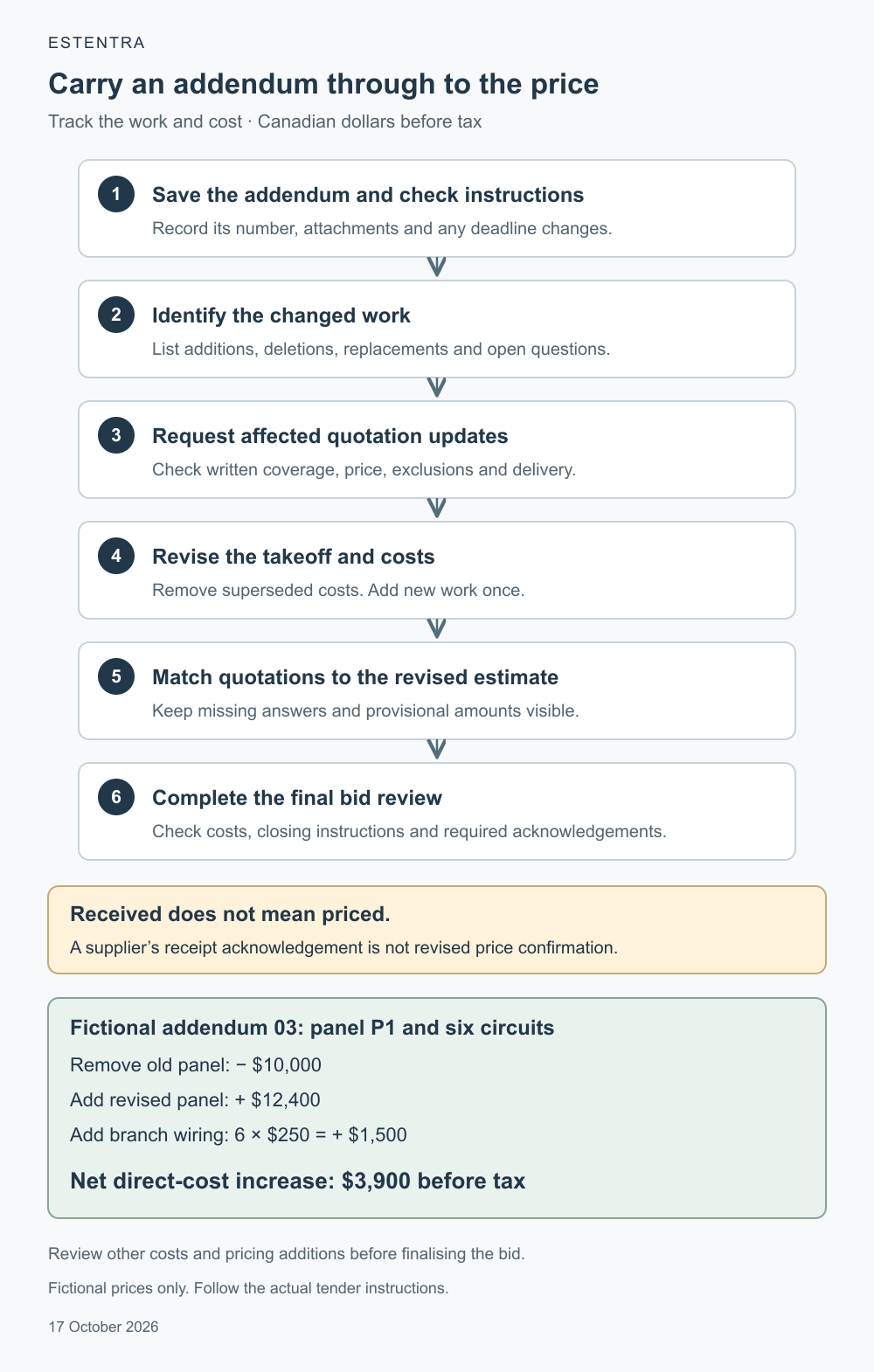
When an addendum arrives, identify its effect on scope, takeoff, suppliers, labour, forms and deadlines. Assign the changes, then record who checked that they reached the estimate and submission. “Downloaded” is not the same as “incorporated.”
The BC Documents Committee’s BCDC 2–2024 guidance explains that addenda can modify bid documents and that late changes need time to be incorporated. Its instructions also address checking that all addenda have been received. Apply the documents used for the actual tender; the guide’s suggested timing is not a nationwide deadline rule. [3]
Track quotation requests by project and package. State the requested return time and follow up on missing or incomplete responses. Review scope, exclusions, quantities and commercial terms before selecting a price. A quotation received just before closing still needs a scope check.
7. Protect final review and submission
Avoid treating review as whatever time remains after takeoff. Reserve it as work with an owner and a scheduled place in the plan. Procurement Assistance Canada recommends having another person review the bid. [1]
Check the scope, latest documents, quotations, labour, allowances, arithmetic and required bid information. Confirm approval responsibilities and the exact files or forms to be submitted. If another reviewer is unavailable, escalate that constraint rather than treating an unchecked estimate as reviewed.
Prepare access and submission arrangements before the final minutes. Check the authorised recipient, required format and the system’s confirmation of submission. Keep the final submitted version and the available receipt or acknowledgement together. A successful transmission does not by itself establish that every tender requirement was satisfied.
For example, Defence Construction Canada’s September 2025 electronic bidding instructions identify the bidding system’s clock as the official closing time and require revisions through that system. They also place responsibility on tenderers to check for updated documents. These are DCC-specific instructions, illustrating why a submission method from one tender must not be assumed for another. [4]
If making a permitted revision, check the applicable process and confirm its final submission status. Continue monitoring the official source through closing as required. An internal target to finish early does not end responsibility for later changes.
8. Example: three tenders and one overloaded estimator
Consider a fictional week in which one estimator has 30 working hours available for tender preparation after other commitments. The estimates below cover that estimator’s own remaining work, including preparing the review package, resolving review comments and preparing the submission. The reviewer’s separate availability must also be scheduled.
| Tender | Closing | Estimated work remaining |
|---|---|---|
| A | Wednesday afternoon | 12 hours |
| B | Thursday afternoon | 14 hours |
| C | Friday afternoon | 10 hours |
| Total | 36 hours |
The plan is short by six hours, even before an unexpected change. Working faster is not a complete resource decision.
The manager could assign a defined six-hour package to a suitably qualified colleague, verify that the colleague is available before that package is needed, and reserve time for its handover and checking. Alternatively, the company could decide not to pursue one opportunity, subject to its commitments and any applicable process.
Neither response is proven workable merely by making the weekly total equal 30 hours. Tender A needs its work completed before Wednesday’s closing, and each reviewer and approver must be available when needed. Check the order of tasks and the daily workload as well as the weekly total.
After each closing, compare planned and actual preparation effort. Record the causes of missed allowances, late information and rework. Use that evidence when deciding how much work to accept next time.
Balancing tenders means making the work, dependencies and available time visible early enough to act. The aim is to complete the bids the company has chosen to pursue with clear scope, a reviewed price and a controlled submission.
References
[1] Public Services and Procurement Canada — Seminar notes: Bidding on opportunities. Federal guidance on preparing, reviewing and submitting bids; each opportunity’s instructions govern.
[2] Canadian Centre for Occupational Health and Safety — Measures for Promoting Mental Health in the Workplace. Clear expectations, competing priorities, balance and workload management.
[3] BC Documents Committee — Guide to BCDC 2–2024, 1 June 2024. Addenda guidance and associated instructions; use the applicable project documents.
[4] Defence Construction Canada — Standard Construction Contract Documents for Electronic Bidding, September 2025, DCL 193E clauses 3.4, 4 and 7. DCC-specific document updates, revisions and closing requirements.
Sources reviewed 1 November 2026. Confirm the current tender instructions and official amendments before preparing or submitting a bid.
General estimating workflow guidance. Project requirements and contractual documents take precedence; this is not electrical design or code-compliance advice.