Tender preparation
Electrical Tender Closing Day: Final Checks Before Submission
Check the final scope, supplier quotations, tender amounts and required documents, then control late changes and confirm submission before closing.
10 min read

Illustrative photograph. Photo by Pilan Filmes on Pexels, used under the Pexels License. Pexels-provided resized image; no other changes.
Closing day brings the estimate, supplier quotations and submission requirements together. The quantities can be carefully measured and the bid still sent with an outdated quotation, an incorrect total or a missing attachment. The final check needs to cover both the work being priced and the submission the recipient will actually receive.
The aim is to reach one approved price, supported by a checked estimate and the correct documents. Give each final task an owner, keep changes visible and leave time to confirm submission.
These are practical estimating recommendations. The applicable tender instructions, amendments and quotation requirements govern each submission. Requirements for an electrical subcontractor quoting a general contractor may differ from those for a contractor bidding directly to an owner.
1. Confirm which deadline and submission you are working towards
Start with the project identification, the intended recipient and the confirmed closing date and time. Check the specified submission method and where the price must be received. An electrical quotation requested by a general contractor may be due before the owner's tender closes. If quoting more than one general contractor, check each recipient's requirements separately.
Confirm whether a bid depository applies. Do not assume that an email to a general contractor satisfies a required depository submission, or that the owner's deadline is also the trade deadline.
Check access, account permissions, required file formats and any upload limits before the final minutes. Arrange a named person to submit and another person to cover that responsibility if needed. They should know which approved version to send.
Procurement Assistance Canada's federal guidance recommends checking the required submission method and deadline. Its preparation reference sheet also highlights requirements that may fall before closing, such as mandatory site visits. These are reasons to establish the submission plan early; closing day cannot be assumed to provide a way to repair a missed prerequisite. [1, 2]
2. Check the latest documents and complete the addendum review
Compare the drawings, specifications and addenda used for the estimate with the official source identified in the tender instructions. Checking a colleague's download folder alone does not establish that the document set is current.
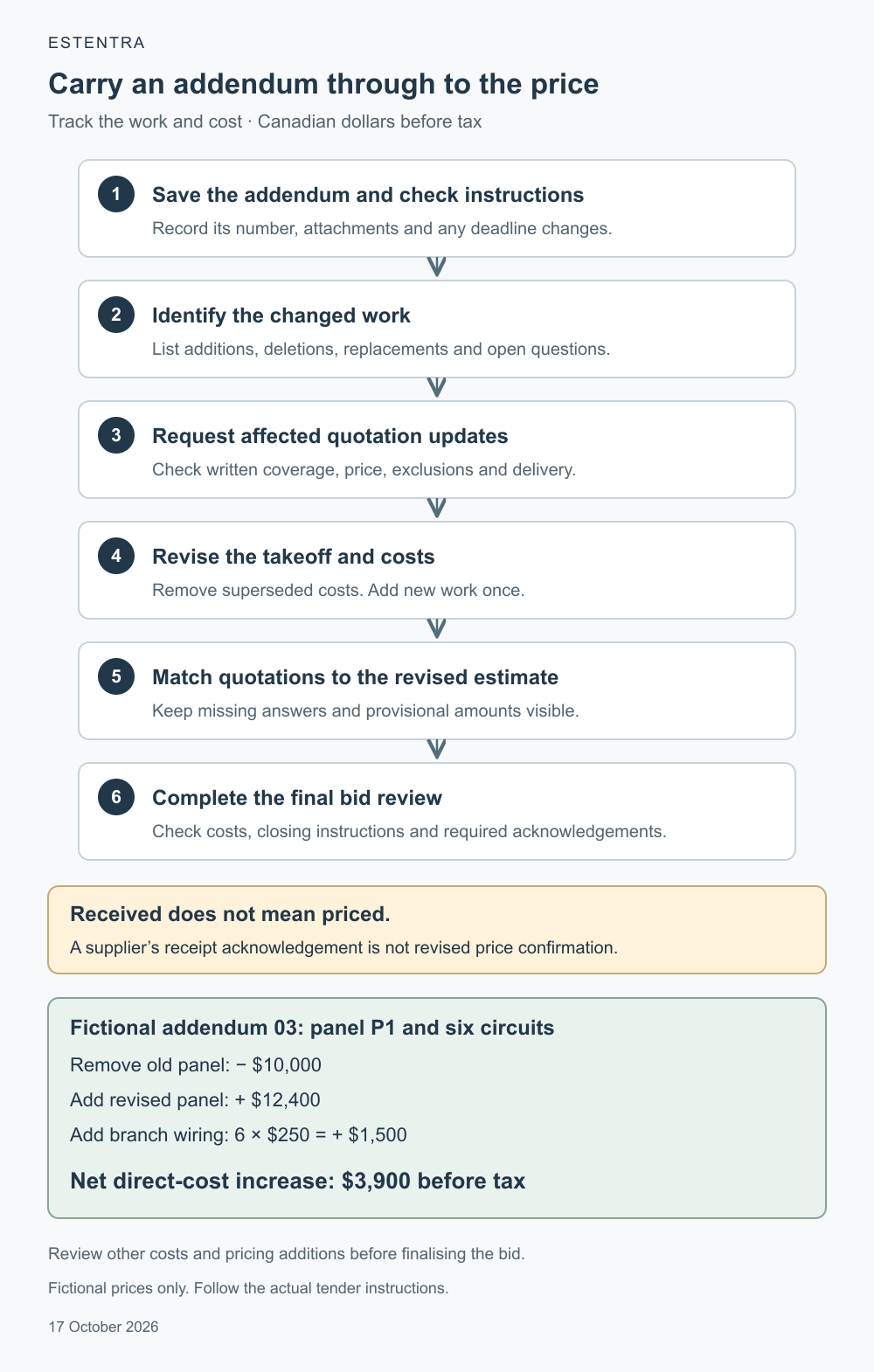
For every addendum, confirm what changed and where that change was included. A revised drawing may affect quantities, labour, supplier pricing, testing or a tender-form entry. An addendum may also change the closing date or submission requirements without changing the electrical drawings.
Use a short record of the change, the person who completed it and the person who checked it. Confirm that relevant suppliers and specialist subcontractors priced the revised requirements. Receiving an addendum is different from completing its effect on the estimate.
The BC Documents Committee's BCDC 2–2024 guidance addresses addenda as changes to bid documents and the time needed to incorporate them. Its accompanying instructions require bidders to check that they have received all addenda. Those provisions are an example from a particular document set, not a universal Canadian deadline rule. [3]
Keep monitoring the official source through closing as required. An internal target to finish early does not stop later changes from needing attention.
3. Reconcile supplier and subcontractor quotations
Review the quotations selected for the estimate, rather than relying only on the latest number in an email. Confirm the project, quotation revision, scope and price. Check whether the supplier has included the current addenda and the specified equipment or an expressly permitted alternative.
For electrical packages, examine items that can leave work unpriced: freight, accessories, supports, terminations, programming, start-up, testing and commissioning. Check who supplies an item and who installs or connects it. The required checks depend on the package; not every quotation includes these services.
Compare exclusions and commercial terms as well as totals. A lower equipment price may leave installation accessories or manufacturer services for the electrical contractor to carry. Record where each required cost is included so it is neither missed nor counted twice.
If a quotation is missing or unclear, name the issue and escalate it to the person authorised to decide how the company will proceed. An internal allowance may help build the estimate, but it does not make an incomplete or qualified submission acceptable under the tender rules. Do not hide an unresolved scope gap in a general contingency.
A late quotation still needs a scope check. If it cannot be checked before it is needed, make that constraint part of the decision rather than silently replacing a reviewed price.
4. Reconcile the estimate with the required price breakdown
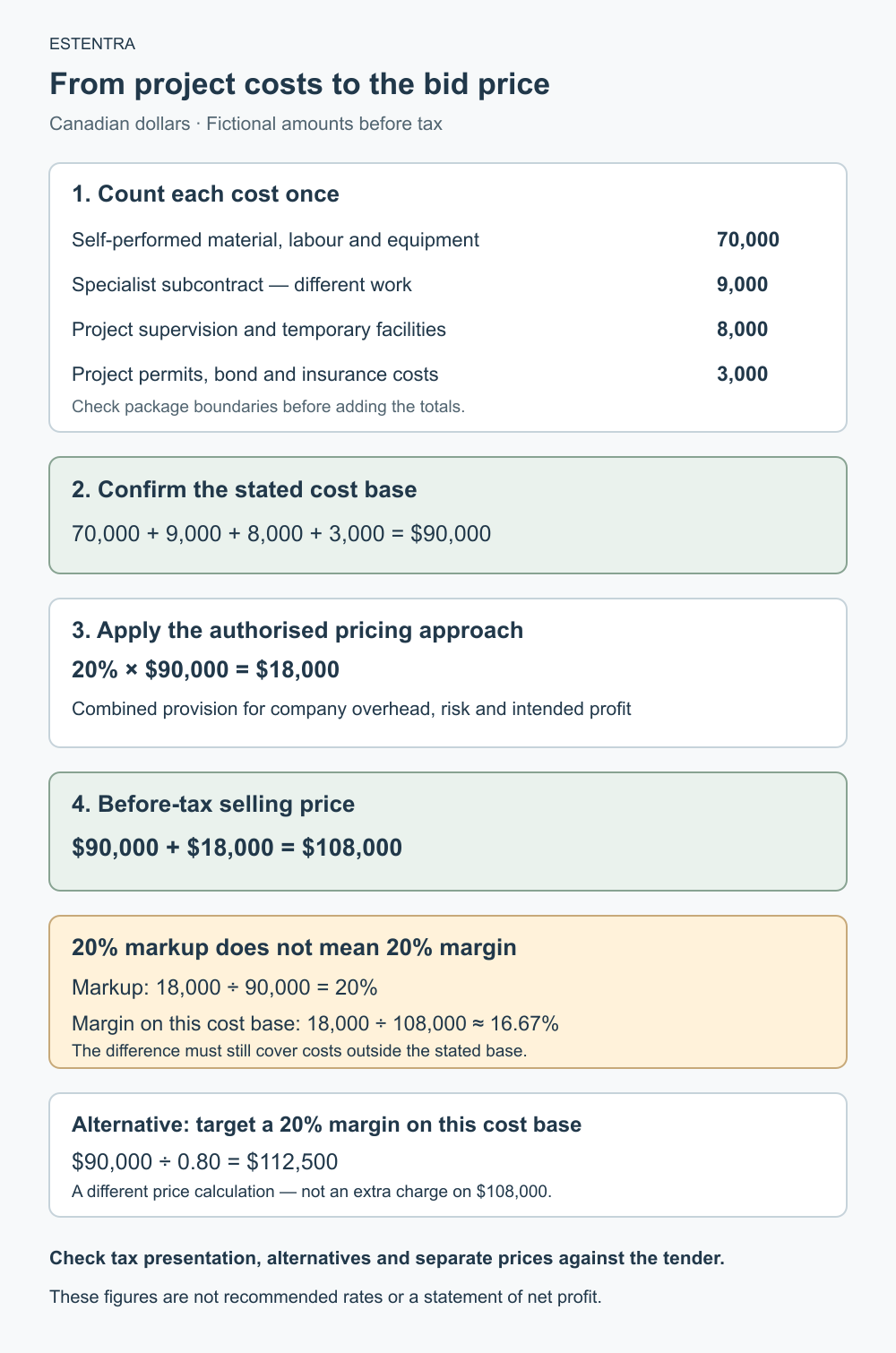
Work from one identified estimate revision. Check that material, labour, equipment, subcontract work and project-specific costs have reached the summary. Look for omitted worksheets, outdated links, hidden rows, manual overrides and formulas that stop before the last item.
Confirm how overhead, profit, allowances and taxes are treated. Follow the tender's pricing instructions; there is no single tax presentation that suits every Canadian bid. Check whether separate prices are additions, deductions, alternatives, unit prices or breakdowns of an amount already included.
| Final check | What it should establish |
|---|---|
| Scope and quantities | Required work is included, including changes and work between trade packages |
| Selected quotations | The summary uses the reviewed quotation revisions and any necessary added costs |
| Labour and project costs | Installation effort and project conditions have been considered |
| Arithmetic and transfers | The checked estimate agrees with the required forms and entered amounts |
| Separate prices and taxes | Each amount follows the instructions and is counted in the intended place |
For example, an illustrative equipment package might include $18,000 for supply and $4,000 for installation, giving $22,000 before other applicable costs or additions. If an alternate removes that package, deducting only the supplier's $18,000 would leave the installation cost in the estimate. Whether the alternate must also adjust overhead, profit or other costs depends on the instructions and the work affected. These figures are fictional and in Canadian dollars.
5. Review the actual submission and obtain approval
Review what will be sent, including portal entries and attachments. Checking the estimate does not automatically check the tender form.
Confirm the correct bidder name, project reference, amounts, required signatures or electronic authorisations, addendum acknowledgements and required schedules. Where called for, check bid security, subcontractor listings and other supporting documents against the instructions. Arrange these items before closing day whenever possible.
Do not assume that a familiar file is the correct version or that every upload requires the same type of signature. For example, Defence Construction Canada's (DCC) September 2025 instructions distinguish a verifiable electronic bid bond from a scanned paper bond. That is a DCC-specific requirement to check where applicable, not a general rule for every electrical quotation. [4]
Procurement Assistance Canada recommends an independent quality review and completion of required bid elements. [1] Give the reviewer enough information to check the final price and submission together. Record the estimate revision and amount approved, who approved them, and any conditions that must be resolved before sending.
Do not add qualifications casually. DCC's cited instructions state that a condition or qualification invalidates its tender. [4] Other procurements have their own rules. Internal approval cannot override them, and a missing requirement cannot be assumed correctable after closing.
6. Control changes after the price has been reviewed
Keep one person responsible for coordinating the final version. Others can investigate questions or check quotations, but changes to the approved total should pass through a visible review and approval process.
When a late change arrives, identify what it replaces, its scope and price effect, and which documents need updating. Update the estimate, the submission amounts and any affected attachments together. Recheck the affected calculations and obtain renewed approval before sending a revised price.
Avoid changing a tender-form total without recording the matching estimate change. That can leave the submitted price disconnected from the company's cost record.
If the bid has already been submitted, read the permitted revision process before acting. Do not assume that editing an uploaded file, saving a portal draft or emailing an explanation changes the submitted bid. DCC's cited instructions, for example, require tender revisions through its electronic bidding system. [4]
7. Submit through the required channel and confirm the result
Allow time for submission, file checking and confirmation. Choose an internal target suited to the system and the submission; a fixed buffer is not a guarantee that a bid will arrive on time.
Open the final files and check the attachments before sending. Confirm the recipient or opportunity, entered amounts and required submission steps. After sending, inspect the system's submission status or the acknowledgement required by the applicable process. Keep the submitted version and available receipt together. A file saved locally or in a portal draft is not evidence that the bid has been submitted.
The federal preparation reference sheet specifically calls for a Connect confirmation email when that submission service is used. [2] Other methods require their own checks. An acknowledgement of transmission does not prove that every tender requirement has been satisfied.
For DCC's cited electronic bidding process, the system's clock establishes the official closing time. Its instructions also do not promise an alternative submission method for a bidder's computer or connection problem. [4] Do not assume a telephone call or ordinary email will replace the prescribed channel, or that a technical problem creates an extension. Follow official instructions and notices.
8. Keep the closing record and follow up
Retain the final estimate, selected quotations, approval record, submitted documents and submission confirmation. Keep superseded versions identifiable so the team can distinguish them from the version actually sent.
If sending electrical quotations to several general contractors, record what each received and when. Where permitted differences exist between those quotations, keep the reasons clear. Do not assume one recipient's acknowledgement confirms receipt by another.
Continue checking for required communications. If an error is discovered after closing, preserve the record and promptly involve the responsible manager and appropriate professional adviser. Do not promise that the price can simply be changed or withdrawn.
After the tender, review which checks found problems and which information arrived too late. Use that record to improve quotation deadlines, review arrangements and preparation for the next closing.
A controlled closing day ends with more than a number sent out. The team should be able to show which scope it priced, which amount was approved, what was submitted and how submission was confirmed.
References
[1] Public Services and Procurement Canada — Seminar notes: Bidding on opportunities. Federal guidance on bid preparation, quality review, required elements and submission.
[2] Public Services and Procurement Canada — Reference sheet: Preparing to bid on an opportunity, updated 8 June 2026. Mandatory requirements, amendments and submission arrangements, including Connect confirmation where used.
[3] BC Documents Committee — Guide to BCDC 2–2024, 1 June 2024. Guideline 1, clause 5 commentary and accompanying Division 00 clause 5. Use the documents applicable to the project.
[4] Defence Construction Canada — Standard Construction Contract Documents for Electronic Bidding, September 2025. DCL 193E clauses 3.2, 4, 5.5, 7 and 16.3. DCC-specific examples, not nationwide tender rules.
Sources reviewed 1 November 2026. Confirm the current project instructions and official amendments before preparing or submitting a bid.
General estimating workflow guidance. Project requirements and contractual documents take precedence; this is not electrical design or code-compliance advice.