Tender preparation
Build the bid total without double counting
Reconcile project costs, pricing additions and tender-form amounts, with a clear example of markup versus margin.
7 min read
Give every cost one clear home, then show how the estimate becomes the price you submit.
All dollar amounts are in Canadian dollars.
A correct takeoff and a good supplier quote can still produce the wrong bid total. Delivery may be included in a quotation and added again in the summary. A subcontract package may cover installation labour that remains in your own takeoff. A percentage may be applied to the wrong subtotal.
The bid summary should make these decisions visible. Another estimator should be able to follow the price from the measured work and quotations through project costs and pricing additions to the tender form.
1. Assemble costs that cover different work
Bring forward the current material, employer labour, equipment and subcontract costs. Record the estimate revision and selected quotation references. Check that the costs reflect the same scope and addenda.
For each package, ask what it already includes. A subcontract price for supply and installation may replace both your material and labour entries for that work. If you retain some work yourself, identify it separately before removing or adding costs.
Review project-specific costs such as site supervision, access equipment, temporary facilities, permits, bonds and project insurance where applicable. Add the required costs that are missing. Do not add an item again merely because it appears on a summary checklist.
For example, if the selected equipment quote includes delivery to site, retain that delivery cost within the quote. Check unloading and positioning separately; “delivery included” does not establish that those services are included too.
2. State the cost base for every addition
A cost base is the subtotal to which a pricing percentage applies. Name the costs in that subtotal and what remains outside it.
Distinguish project costs from company overhead and the amount intended to provide profit. Keep an internal risk allowance identifiable, with its purpose and basis. Check whether the same uncertainty is already covered in a quotation, labour allowance or another provision.
Ontario MTO's February 2023 draft estimating guide separates resource costs from overhead and profit in its cost-based method. [1] That is useful construction context; its highway-project procedures are not general electrical-tender requirements.
Use the company's authorised pricing method. It may use separate additions or one combined markup. Either way, record the amount or percentage and its base. A combined addition must not be described entirely as profit when it also needs to cover company overhead or risk.
Check the order of percentage additions. On $100,000, adding 5% and then 10% of the revised subtotal gives $115,500. Adding both percentages to the original $100,000 gives $115,000. Neither sequence should be selected by accident.
If a fee or charge is calculated on selling price, obtain or calculate it on that stated basis. Applying its percentage to cost instead produces a different amount. Reconcile any price-dependent charge with the final selling price before approval.
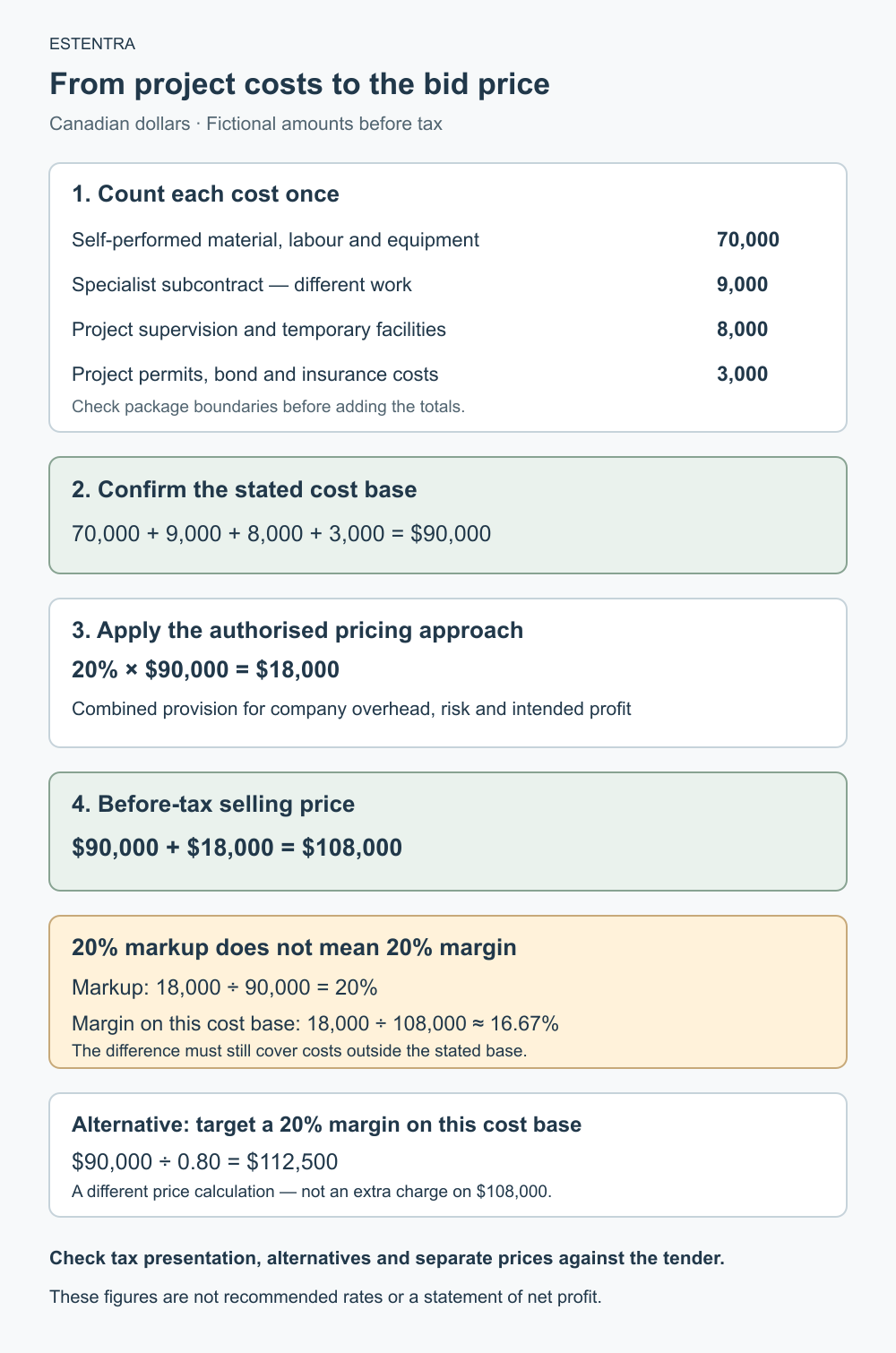
Example: from project costs to the bid price
Consider a fictional electrical estimate. All figures are before tax. Each entry below covers different work; selected quotations and internal allowances have been checked for overlap.
| Cost entry | Amount | Basis in this example |
|---|---|---|
| Self-performed material, employer labour and equipment | $70,000 | Includes the identified delivery, handling and equipment allowances. |
| Specialist subcontract | $9,000 | Covers different work, with none of its scope left in the self-performed total. |
| Project supervision and temporary facilities | $8,000 | Required project costs outside the first two entries. |
| Project-specific permits, bond and insurance costs | $3,000 | Confirmed fictional task costs, included once. |
| Stated cost base | $90,000 | 70,000 + 9,000 + 8,000 + 3,000. |
For this teaching example, the authorised pricing approach adds 20% of the $90,000 cost base as one combined provision for company overhead, risk and intended profit. These are fictional pricing choices, not recommended percentages.
- Combined addition: $90,000 × 20% = $18,000.
- Before-tax selling price: $90,000 + $18,000 = $108,000.
The $18,000 difference is available to cover the items deliberately left outside the stated cost base. It is not $18,000 of net profit. Actual costs, overhead and the outcome of the work will affect the result.
The diagram follows this same calculation. It also shows why the 20% markup does not produce a 20% margin on the selling price.
3. Keep markup and margin distinct
Markup uses cost as its denominator. Margin uses selling price. BDC explains markup as a percentage of cost and notes that pricing must also provide for indirect costs and intended profit. [2]
For the example:
- Markup on the stated cost base: 18,000 ÷ 90,000 × 100 = 20%.
- Margin on that same stated cost base: 18,000 ÷ 108,000 × 100 ≈ 16.67%.
To obtain a 20% margin on the stated cost base, the before-tax price would instead be $90,000 ÷ (1 − 0.20) = $112,500. The difference would be $22,500. This is an alternative calculation, not a further addition to $108,000.
Always say which costs the margin calculation includes. If company overhead is outside that base, this percentage is not a net-profit margin. At a zero selling price, the margin percentage is undefined because its denominator is zero.
4. Match the total to the tender form
Read the instructions for the base bid, separate prices, alternatives, unit prices and any required allowances. Record whether each amount belongs in the base total or is presented separately.
Do not add every price on a form together. An alternative may replace part of the base work, while another amount may be an optional addition. Follow the actual instructions rather than assuming every tender uses those labels in the same way.
Keep the internal cost build-up and the submitted pricing schedule reconcilable. If a required unit price must include overhead and profit, do not copy a direct unit cost into that field without completing the required pricing.
Procurement Assistance Canada directs federal bidders to understand the requirements and follow the bid-preparation instructions. [3] For other projects, use the instructions governing that tender. Resolve unclear price treatment through its stated question process.
5. Make the tax basis clear
State whether the submitted price includes applicable tax or whether tax is shown separately, as required by the tender. CRA guidance requires customers to be told whether GST/HST is included in the price or added separately. [4]
Check the project's tax treatment with the person responsible for the company's tax calculations. Keep any tax included in purchase quotations visible so it is handled consistently in the estimate. This article does not calculate tax, determine recoverability or prescribe a rate.
Before releasing the bid
Reconcile the summary to the supporting estimate, selected quotations and current addenda. Check the percentage bases, additions, tax presentation, rounding and every amount copied to the submission form.
Confirm quotation validity and any unresolved conditions. Have the authorised reviewer approve the exact price and its assumptions before it is issued. A correct total means more than correct addition: the required work must be included, each cost must be counted once, and the submitted figures must follow the tender instructions.
References
- Ontario Ministry of Transportation: Draft Cost Estimating Guide for Designers, February 2023, section 8.6, printed pages 13–14. The cover labels the document “Draft.” Highway-estimating context only.
- BDC: 7 steps to setting the right price for your products or services, section 4, “Determine your markup.” General business-pricing context; no recommended contractor percentage taken from it.
- Procurement Assistance Canada: Preparing to bid on an opportunity, “Review and understand an opportunity” and “Prepare your bid document.” Federal procurement context.
- Canada Revenue Agency: Charge and collect the GST/HST, “Receipts and invoices.” Supports disclosure of tax treatment, not a tax calculation for this example.
References checked 19 October 2026. All amounts, percentages and cost assignments are fictional teaching inputs. The reconciliation workflow and worked examples are original educational guidance.
General estimating workflow guidance. Project requirements and contractual documents take precedence; this is not electrical design or code-compliance advice.