Electrical Systems & Specifications
Wires and Cables Under Division 26
Understand Canadian wire and cable designations, ratings, conductor and cable quantities, terminations and installation scope for complete Division 26 estimates.
9 min read
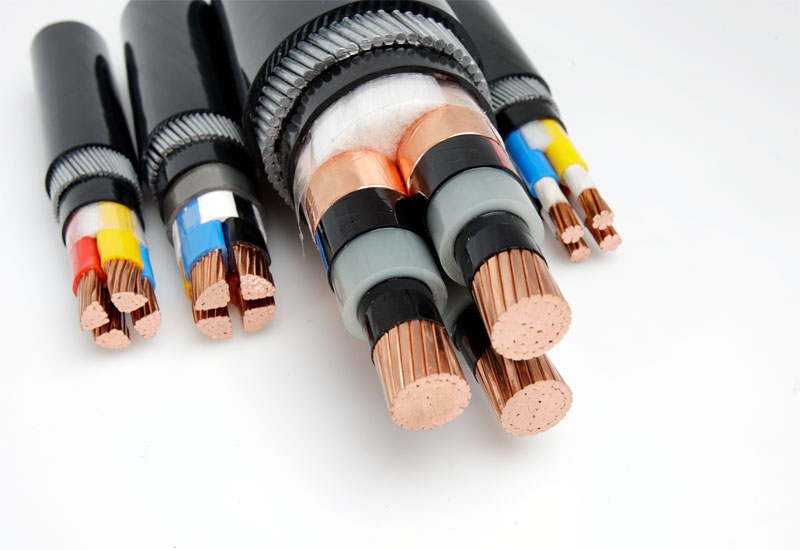
Illustrative cable constructions, not identification of the Canadian cable types discussed below or evidence of Canadian certification. “Power cables” by Pawarbhushan, CC BY-SA 4.0. No changes.
A cable designation is a starting point for an estimate, not a complete material description. The conductor material, size, number of conductors, voltage rating, construction and installation conditions all matter. So do the connections and labour needed to turn a measured length into a working installation.
Start with the single-line diagram, cable and equipment schedules, specifications and installation details. The National Research Council’s NMS section list includes 26 05 21 — Wires and Cables (0–1000 V) and 26 05 22 — Connectors and Terminations. Review the project’s actual sections together rather than assuming that cable supply includes every connection. [1]
This article covers common building and industrial wiring at an introductory estimating level. Use the code adopted in the project’s province or territory, local amendments, project requirements and current manufacturer information. Conductor sizing, protection and installation design require their own review; they cannot be determined from a cable name alone.
1. Separate conductors from cable assemblies
A conductor is the metal part that carries current. It may be solid or made from multiple strands. An insulated single conductor has insulation around that metal. A cable assembly may contain one or more insulated conductors together with other components, such as a bonding conductor, jacket, shield or armour.
Strands are not separate circuit conductors. A stranded conductor still counts as one conductor in the takeoff. Likewise, a cable containing several circuit conductors is purchased and measured as a cable length, not as several separate lengths of that complete cable.
Canadian product sheets show both single-conductor products and assemblies containing several conductors. Read the construction description, not just the photograph or a shorthand description such as “four-wire cable.” [2][4][5]
For every item, make the quantity basis clear: metres of a specified single conductor, metres of a specified cable assembly, or a separately defined installation assembly.
2. Recognise common Canadian designations
The following examples explain what to look for. They are not a selection chart or permission to substitute one wiring method for another.
| Designation | What the product description tells you | What still needs checking |
|---|---|---|
| RW90 | Commonly supplied as a thermoset-insulated single conductor; the cited Prysmian copper product is rated for wet or dry use in raceways | Specified voltage, conductor material and size, sunlight marking, installation method and any additional tray qualification [2] |
| RWU90 | An insulated single-conductor product; the cited Southwire copper product is designed for direct earth burial with protection as required by the inspecting authority | Exact product rating, approved use, protection, routing and project restrictions [3] |
| AC90 | Armoured cable; the cited Southwire copper construction includes insulated circuit conductors, a bonding conductor and interlocked armour, for dry-location use | Conductor count and sizes, bonding conductor, connectors and permitted installation locations [4] |
| TECK90 | Armoured and jacketed cable; Northern Cables describes insulated conductors, an inner jacket, interlocked armour and an outer jacket | Copper or aluminum construction, conductor count, voltage, dimensions, markings and fittings appropriate to the application [5] |
Do not assume that TECK90 always means copper. Canadian manufacturers offer aluminum-conductor TECK90 as well. Also distinguish the material of the circuit conductors from the material of the armour: aluminum armour does not mean that the circuit conductors are aluminum. [4][5]
This is not an exhaustive list. Residential, control, instrumentation, variable-frequency-drive, photovoltaic and life-safety systems can call for other products. Keep the exact type and construction shown in the project documents.
3. Read ratings as separate requirements
Voltage rating, conductor temperature rating, flame-test markings, sunlight resistance and installation-temperature limits answer different questions. A product that satisfies one requirement does not automatically satisfy the others.
The 90 in these common designations relates to a 90°C conductor temperature rating. It does not mean that every connected item of equipment permits the conductor’s 90°C ampacity—the current it can carry under the applicable conditions.
Schneider Electric Canada explains this distinction for its moulded-case circuit breakers: a breaker marked for 75°C conductors can accept appropriately selected 90°C-insulated conductors, but sizing must respect the breaker’s marked temperature limitation. Check the equipment and termination requirements at both ends rather than treating the insulation rating as the whole answer. [7]
Tray use also needs a specific check. Southwire publishes an RW90 FT4 tray-rated product with stated qualifications. Do not assume every product bearing RW90 has the same tray qualification, or that a flame-test marking alone settles all cable-tray requirements. Confirm the complete marking, cable construction and permitted wiring method. [2][6]
Product sheets can also distinguish a cold-bend or impact rating from the minimum installation temperature. Use the current handling and installation instructions when planning cold-weather work; the two temperatures are not interchangeable. [6]
4. Measure the route and count the specified conductors
Trace the route between its actual termination points. Include the documented rises, drops, equipment entries and length needed for connections. Record any estimating allowance separately so another reviewer can distinguish a measured route from an assumed addition.
For single conductors, count the required phase, neutral and bonding conductors by their specified sizes and types. Do not assume that every circuit uses the same number of conductors, that the neutral matches the phase conductors, or that every bonding conductor is separately installed. Read the design and cable construction.
For a cable assembly, measure the complete cable once along its route. Check how the manufacturer states the conductor count and identifies any included bonding conductor. Otherwise, the estimate can omit a required component or price one twice.
Keep parallel runs identifiable. A schedule calling for two sets needs the defined components of both sets. It does not authorise the estimator to alter the number, size or arrangement of conductors to suit stock availability.
5. Price the connections as well as the length
Cable purchase is only part of the installed cost. Check what arrives with the equipment, what the cable supplier includes and what the electrical contractor must provide.
| Scope item | Question to resolve before pricing |
|---|---|
| Cable entry fittings | Which connectors, glands, adapters and sealing components match the cable construction, dimensions, enclosure and location? |
| Conductor terminations | What lugs, terminals, splice kits and preparation are specified, and which items are included with the equipment? |
| Bonding and shields | What connections are shown, and who completes and verifies them? |
| Identification | What circuit labels, conductor identification, tags and records are required? |
| Supports and protection | Are cleats, straps, transition protection, sleeves and other supports included in this item or elsewhere? |
| Completion | What inspection, testing, witnessing and handover work belongs in the price? |
A connector for the cable’s outer construction and an electrical termination for a conductor are different items. Two cable ends do not necessarily mean only two electrical connections. Describe what the rate includes, particularly when equipment suppliers provide some of the termination components.
6. Allow for the actual installation conditions
A short route can still involve difficult handling, access, pulling or termination work. Review reel delivery and positioning, pulling equipment, working height, congestion, shutdowns and the sequence in which the work can be completed. Include relevant equipment and labour without duplicating costs already carried elsewhere.
Confirm the manufacturer’s limits for pulling and bending rather than applying one generic radius or pulling allowance to every cable. If the specified cable and route appear incompatible, raise a clarification before final pricing.
Owner specifications can add completion requirements. Metrolinx’s September 2025 electrical-conductors-and-cables specification includes cable protection, identification, termination work and testing. It is a useful example of why an estimate needs more than material lengths. Its detailed installation and acceptance requirements apply to the relevant Metrolinx work; they are not national requirements for every project. [8]
Confirm the project’s test methods, acceptance criteria, timing and responsibility. Do not carry a test voltage or acceptance value from another job into this one without checking the applicable requirements.
7. Example of conductor metres versus cable metres
Consider a fictional takeoff in which a drawing specifies four insulated single conductors and one separate bonding conductor. The measured route is 24 m, the documented rise adds 3 m, and the estimator records an assumed 2 m combined allowance at the ends for review.
Each conductor’s stated length is therefore 29 m. The four insulated conductors total 116 conductor-metres. The bonding conductor adds 29 m, recorded as its own item at its specified size. Even if the lengths are added for a quantity check, they must not be priced as one undifferentiated cable item.
If a separate hypothetical design instead calls for one complete multicore cable assembly along that same stated length, the takeoff would record 29 m of that cable assembly, not four times its length. These are counting examples, not interchangeable circuit designs or recommended allowances.
Before ordering, review the actual termination lengths, required continuous cuts and reel lengths. Keep purchasing allowances and unusable offcuts separate from the measured installed quantity. Do not assume that enough total cable on several reels guarantees the continuous lengths required.
8. Review the complete cable item
A reviewer should be able to identify the specified cable or conductor, its quantity basis, the route and allowances, the included connections, and the installation and completion work.
Check any substitutions against the project’s approval process. Matching only the conductor size or temperature designation is not enough. If the type, rating, construction, termination requirements or responsibility split remains unclear, record the question, its owner and when the answer is needed. Resolve it or obtain an authorised estimating decision consistent with the tender instructions before finalising the price.
References
[1] National Research Council Canada — NMS section list, April 2026, Division 26 section titles.
[2] Prysmian — RW90 High Speed Cable, SPEC 5510, Canadian-market product construction, ratings and applications.
[3] Southwire Canada — SIMpull RWU90 Copper, product construction and application. The sheet’s older code-based ampacity tables are not used here.
[4] Southwire Canada — AC90 Copper, construction and dry-location application. Its older code-based ampacity tables are not used here.
[5] Northern Cables — TECK90 product specifications, copper and aluminum constructions and product markings.
[6] Southwire Canada — RW90 FT4 Tray Rated Cable, Copper, product qualifications, operating ratings and installation temperature.
[7] Schneider Electric Canada — Can 90 degree celsius wire be used on a circuit breaker?, modified 5 January 2026. Product guidance on insulation and breaker termination temperatures.
[8] Metrolinx — Electrical Conductors and Cables, Section 26 05 21, September 2025. Owner-specific requirements for installation and completion work.
Sources reviewed 30 October 2026. Confirm the applicable code edition, project requirements and current product information before pricing the work.
General estimating workflow guidance. Project requirements and contractual documents take precedence; this is not electrical design or code-compliance advice.