Electrical Systems & Specifications
Wiring Devices Under Division 26
Understand receptacles, switches, protection features and Canadian approval marks, with practical checks for device, box and plate quantities and complete installed costs.
10 min read
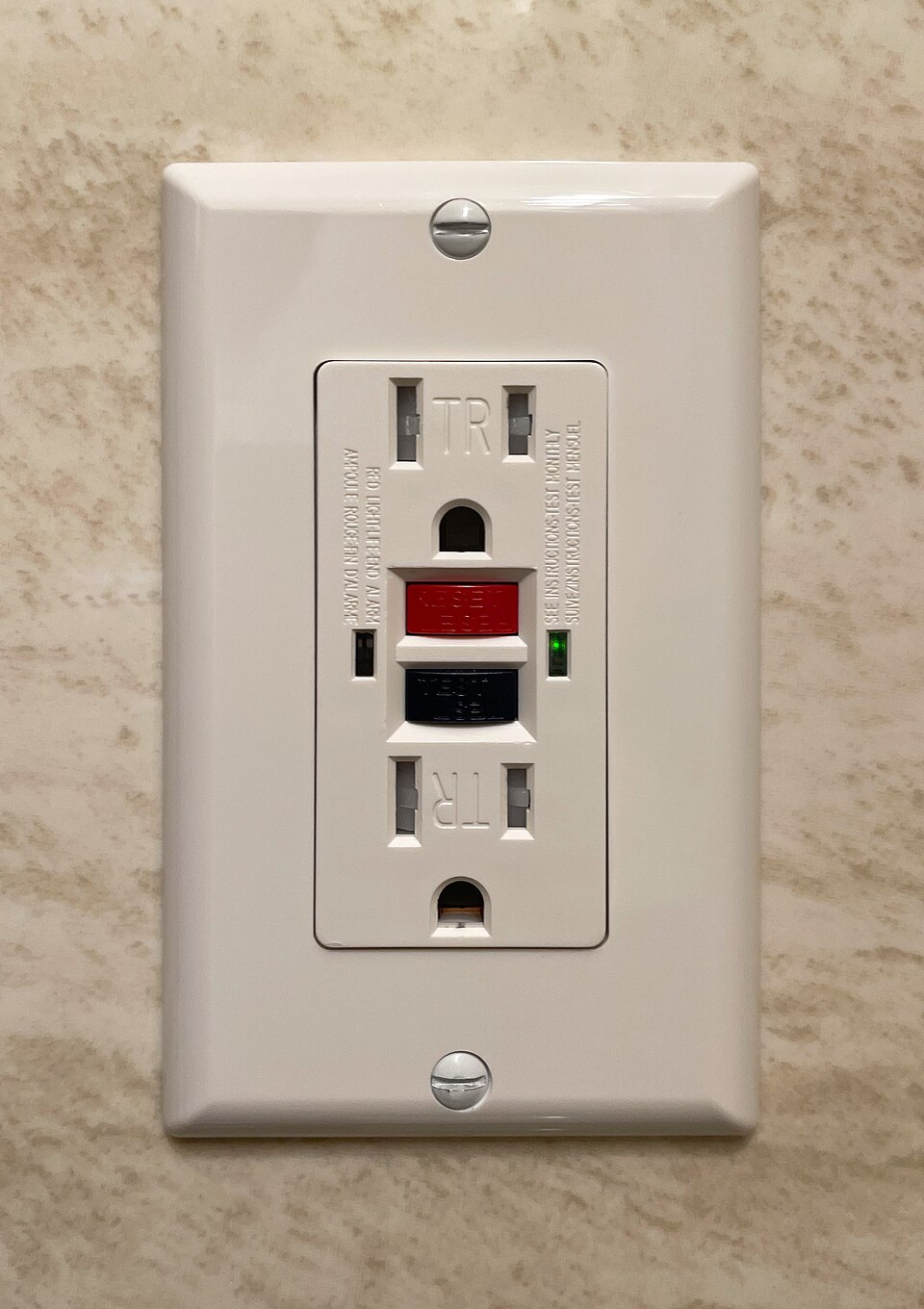
Illustrative North American device; the photograph does not establish Canadian certification or suitability for a particular installation. “Residential GFCI receptacle” by Ben Kurtovic, CC BY-SA 4.0. Wikimedia-provided resized image; no other changes.
Receptacles and switches are small items with a large effect on the finished electrical installation. A drawing symbol may look simple, but its price depends on the device rating, protection features, mounting arrangement, cover plate and connections. Counting symbols is only the beginning.
The National Research Council’s NMS section list identifies 26 27 26 — Wiring Devices. It lists outlet boxes, multi-outlet assemblies and lighting controls in other sections as well. Read the project’s actual specifications and details together; a section number alone does not define everything included in a device installation. [1]
This article explains the estimating checks for common building wiring devices. Use the electrical code adopted in the project’s province or territory, local amendments, project documents and current manufacturer information. It does not provide circuit design, receptacle-spacing rules or installation instructions.
1. Identify the device before counting it
A receptacle provides a connection point for a matching attachment plug. A switch controls a circuit or load. The appearance of either device does not tell you its complete rating or intended application.
Separate single and duplex receptacles, locking receptacles, switches, combination devices and special-purpose products in the takeoff. Keep devices with USB charging, alarms or other specified functions identifiable rather than grouping them under one general receptacle rate.
For conventional lighting switching, a single-pole switch controls the load from one location. A pair of three-way switches allows control from two locations. Four-way switches can be used between the three-way switches for additional locations. These names do not mean three or four switches must be purchased for every symbol. Check the actual switching arrangement. [2]
A wall-mounted dimmer, occupancy sensor or control station can look like an ordinary switch while requiring different wiring, compatible equipment or setup. Coordinate these items with the lighting-control scope so they are included once and priced correctly.
2. Read ratings and product features separately
Start with the specified current and voltage ratings, plug configuration, device grade, conductor compatibility and mounting requirements. Then check additional functions and environmental suitability.
Canadian-market catalogues distinguish residential and commercial devices, different current ratings, and single-pole and three-way switches. Eaton’s Canadian product page for one GFCI receptacle separately states its 20 A, 125 V rating, 5-20R configuration, terminal wire range and certification information. These are separate selection checks, not interchangeable descriptions. [3][4]
Do not substitute a device because its colour, face shape or current rating matches. A product with a similar appearance may have different terminals, protection features, dimensions or approved uses. Where the specification names a grade or model, keep that requirement in the price and follow the stated substitution process.
For an equipment receptacle, confirm the matching plug configuration and whether the plug is supplied with the equipment. Record who supplies any required attachment plug or connector. Do not assume that the equipment supplier and electrical contractor have included the same components.
3. Understand the different protection features
Several features can be combined in one product, but each answers a different need.
| Feature | What it does | What to confirm in the estimate |
|---|---|---|
| GFCI — ground-fault circuit interrupter | Interrupts the supply when it detects a ground fault, helping protect people against electric shock | Required protection arrangement, device type, testing and identification [5][6] |
| AFCI — arc-fault circuit interrupter | Detects hazardous arcing conditions and interrupts the circuit to reduce fire risk | Specified protection method and the equipment providing it [5] |
| Tamper-resistant (TR) | Uses a shutter mechanism to restrict access to the receptacle contacts | Required locations and the specified product; TR is a separate feature from GFCI or AFCI protection [6][3] |
| Weather-resistant (WR) | Identifies a device intended for the stated outdoor/environmental application | Exact device rating plus the required box, cover and complete assembly [3][7] |
Ontario’s Electrical Safety Authority discusses GFCI and AFCI as different forms of protection. Technical Safety BC also explains GFCI protection and the shutter action of tamper-resistant receptacles. Use these explanations to understand the functions; check the applicable code and project requirements for where each is required. [5][6]
Do not treat “GFCI-protected” on a drawing as a complete bill of materials. Confirm whether the design provides protection at the receptacle, through a specified upstream device, or at the breaker. Keep the protective equipment and the receptacles it serves accounted for without assuming a different design to reduce cost.
Likewise, a weather-resistant receptacle is not the whole outdoor installation. Check the enclosure, cover, gaskets, mounting orientation and protection required while a plug is connected. Eaton’s Canadian cover range includes complete kits with a box, in-use cover and GFCI device, illustrating why a quoted kit needs to be checked before adding its components again. [7]
4. Check Canadian approval and project requirements
Check the product’s certification information and the actual approval mark appropriate to the jurisdiction and application. A familiar brand or a statement that an item is sold in Canada is not a substitute for checking the product.
For Ontario, ESA publishes recognised certification and evaluation marks and explains that component-recognition marks are not approval of complete end-use products. Its list includes multiple agencies; approval is not limited to one organisation’s logo. Confirm the requirements with the relevant authority for projects elsewhere in Canada. [8]
Owner requirements can be more specific than a general device description. Metrolinx’s September 2025 receptacles-and-plugs specification addresses device grade, identification, covers and completion checks. Those are owner-specific requirements, not national rules for every building. Read the version included in the tender rather than adopting another owner’s requirements by default. [9]
5. Count devices, boxes and plates as different items
State the unit used for each takeoff quantity. A duplex device has two plug-in positions, but a takeoff counting complete duplex devices records one purchased device for that item. This is a purchasing convention, not a method for determining code circuit limits or loads.
Read the legend before interpreting a “quad” or similar symbol. A detail may show two duplex devices in one two-gang box, or a different assembly. Count the components actually specified.
| Item | Takeoff check |
|---|---|
| Device | Exact type, rating, grade, features, colour and quantity of complete units |
| Box | Number of locations, gangs, depth, construction and mounting arrangement |
| Cover plate | Number of complete plates, opening pattern, material and finish |
| Outdoor assembly | Box, compatible device, cover, seals and other specified fittings |
| Connections | Required conductors, bonding connections, terminals and installation labour |
| Completion | Labels, checks, testing and records required by the project |
A multi-gang plate can serve several devices. Its opening pattern must match those devices. Do not automatically buy one single-gang plate for every switch or receptacle.
If the estimating software uses an assembly rate, review its contents. A rate that already includes a box and plate must not receive a second allowance for those same items. Conversely, a device-only supplier price does not cover the whole installed assembly.
6. Allow for mounting, coordination and completion
Check wall, ceiling, floor and equipment-mounted details. Flush and surface installations can require different boxes, supports and covers. Coordinate locations and mounting heights with architectural drawings, casework, accessibility requirements and equipment layouts. Raise conflicts rather than choosing a generic mounting height.
For grouped dimmers and electronic controls, check the actual product’s box-space, load-compatibility and installation requirements. Do not assume they use the same labour or accessories as a mechanical switch. Keep control setup and testing with the responsible scope.
Renovation work also needs a clear boundary: replacement, relocation, new installation or removal. Establish who traces existing circuits, arranges shutdowns and completes any specified repairs to finishes. Count these tasks from the project requirements rather than hiding them in an unexplained percentage.
Include identification and verification work. As one owner-specific example, the cited Metrolinx specification calls for panel/circuit identification and checks of polarity, ground continuity and GFCI manual trip/reset functions. Use the project’s own testing and acceptance requirements; this example is not a universal test procedure. [9]
7. Example: two devices do not always need two boxes
Consider a fictional room layout with:
- Ten separate locations, each containing one specified duplex receptacle in a single-gang box.
- Two locations, each detailed as two duplex receptacles in one two-gang box with one matching two-gang plate.
- One separate single-pole switch location with its own box and plate.
The receptacle takeoff contains 14 complete duplex devices: ten individual devices plus four devices at the two grouped locations. It contains 12 receptacle boxes, 10 single-gang duplex plates and two two-gang plates with the specified openings.
The switch adds one switch, one switch box and one matching plate. Across this example there are therefore 15 devices, 13 boxes and 13 plates, before checking accessories and the contents of any purchased kits.
The numbers illustrate component counting only. They do not establish circuit loading, circuit quantity, required spacing or protection. Those checks come from the actual design and applicable requirements. Wiring, supports, identification and completion work must still be included somewhere in the estimate.
8. Review the complete device installation
A reviewer should be able to follow each device from its drawing symbol to its specification, quantity and installed cost. Check that the selected product, box, plate, protection arrangement and connections describe the same installation.
Before final pricing, resolve unclear symbols, missing ratings, conflicting finishes and uncertain supply responsibilities. Record the question, who will obtain the answer and when it is needed. If an answer cannot be obtained, seek an authorised estimating decision consistent with the tender instructions rather than silently substituting a cheaper device or omitting work.
References
[1] National Research Council Canada — NMS section list, 2026-04 update. Section titles and organisation; the full specification is not reproduced here.
[2] Leviton — Commercial and Industrial Switches brochure. Explanation of single-pole, three-way and four-way switching. Used for product terminology, not U.S. code requirements.
[3] Leviton Canada — Lever Edge product brochure. Canadian-market ratings, grades and distinct TR, WR and GFCI features.
[4] Eaton Canada — TRSGFA20BK GFCI receptacle. A product-specific example of ratings, configuration, terminals and certifications.
[5] Electrical Safety Authority — Are You Using the Right Outlet?. Ontario consumer guidance on GFCI, AFCI and tamper-resistant receptacles. Location rules and exceptions are not reproduced as a national code checklist.
[6] Technical Safety BC — Electrical Safety. GFCI function, tamper-resistant shutters and the role of cover plates.
[7] Eaton Canada — Extra Duty While-in-use Covers and Kits. Cover and kit components. U.S. NEC references on the product page are not used as Canadian installation rules.
[8] Electrical Safety Authority — Recognized Approval Marks. Ontario approval marks and the distinction between components and complete products.
[9] Metrolinx — Electrical Receptacles and Plugs, Section 26 27 26, Revision 02, September 2025. Owner-specific examples of identification and completion scope.
Sources reviewed 30 October 2026. Confirm the applicable code edition, project requirements and current product information before pricing the work.
General estimating workflow guidance. Project requirements and contractual documents take precedence; this is not electrical design or code-compliance advice.