Estimating workflow
How to Build an Electrical Unit Rate
Build an electrical unit rate from material, labour and equipment costs. Follow a worked example and see how quantity changes affect the cost per unit.
7 min read
Show the materials, person-hours and equipment cost needed for one clearly defined unit of work.
A rate of “$35 each” is useful only if you know what “each” includes. Does it cover the material, installation labour and equipment? Is it a direct cost or a selling price? What conditions must be true for the rate to apply?
A checkable unit rate answers those questions and shows the calculation. Another estimator should be able to change a material price or labour allowance without rebuilding the whole estimate.
1. Define one unit of completed work
Start with a description and an output unit: one support assembly, one device or one metre of a specified installation. Identify the drawing or detail, material type, included tasks and working conditions.
Keep different work separate when it needs a different rate. Installing a bracket on an accessible wall is not automatically the same task as installing one at height or in a restricted shutdown period.
State the exclusions as well. If raceway, cable, specialist testing or access equipment is priced elsewhere, say so. A short description prevents someone from applying the rate to a more complete package than you priced.
Statistics Canada's building-construction price-index guide records material, labour and equipment costs within component unit rates, then extends those rates by quantity. [1] That supports showing the resources behind a unit rate. The guide explains an index methodology; it does not supply the prices for this example.
2. Calculate the material cost per installed unit
List the materials needed for one unit of completed work. Multiply each material quantity by its price on the same quantity basis, then add the amounts.
Record the quotation reference, date and what the price includes. Check delivery, purchasing allowances, packaging and minimum order quantities before deciding what material cost to allocate to the task. Keep those decisions traceable to the original takeoff and quotation.
Check the pricing unit carefully. A quotation of $400 per 100 fixing sets means $4 per set, not $400 per set. The pricing unit does not, by itself, tell you whether the supplier requires you to buy a whole pack of 100. Confirm that separately.
If a small task requires buying a whole pack, account for the actual purchase and any allocation to other work. Do not assume unused material has no cost or a guaranteed return credit.
3. Calculate labour with matching hours and rates
Record the person-hours per installed unit, then multiply by the cost per person-hour. A person-hour means one person's work for one hour.
For example, 0.4 person-hours per assembly × $50 per person-hour = $20 per assembly. The hours and hourly cost must refer to the same labour basis. Do not multiply person-hours by the total hourly cost of a multi-person crew.
State what the hourly cost includes, such as the employer costs included alongside wages, and what is priced elsewhere. Use the contractor's reviewed cost for the intended work period. An example hourly figure is not a current wage, payroll burden or recommended charge-out rate.
Check that the labour allowance covers the described tasks and conditions. If setup or handling is already included, do not add the same work again as a separate allowance.
4. Allocate equipment and fixed charges visibly
Identify the equipment needed for the task and its charging basis. A supplier may charge by the hour, day or week, or impose a minimum hire period.
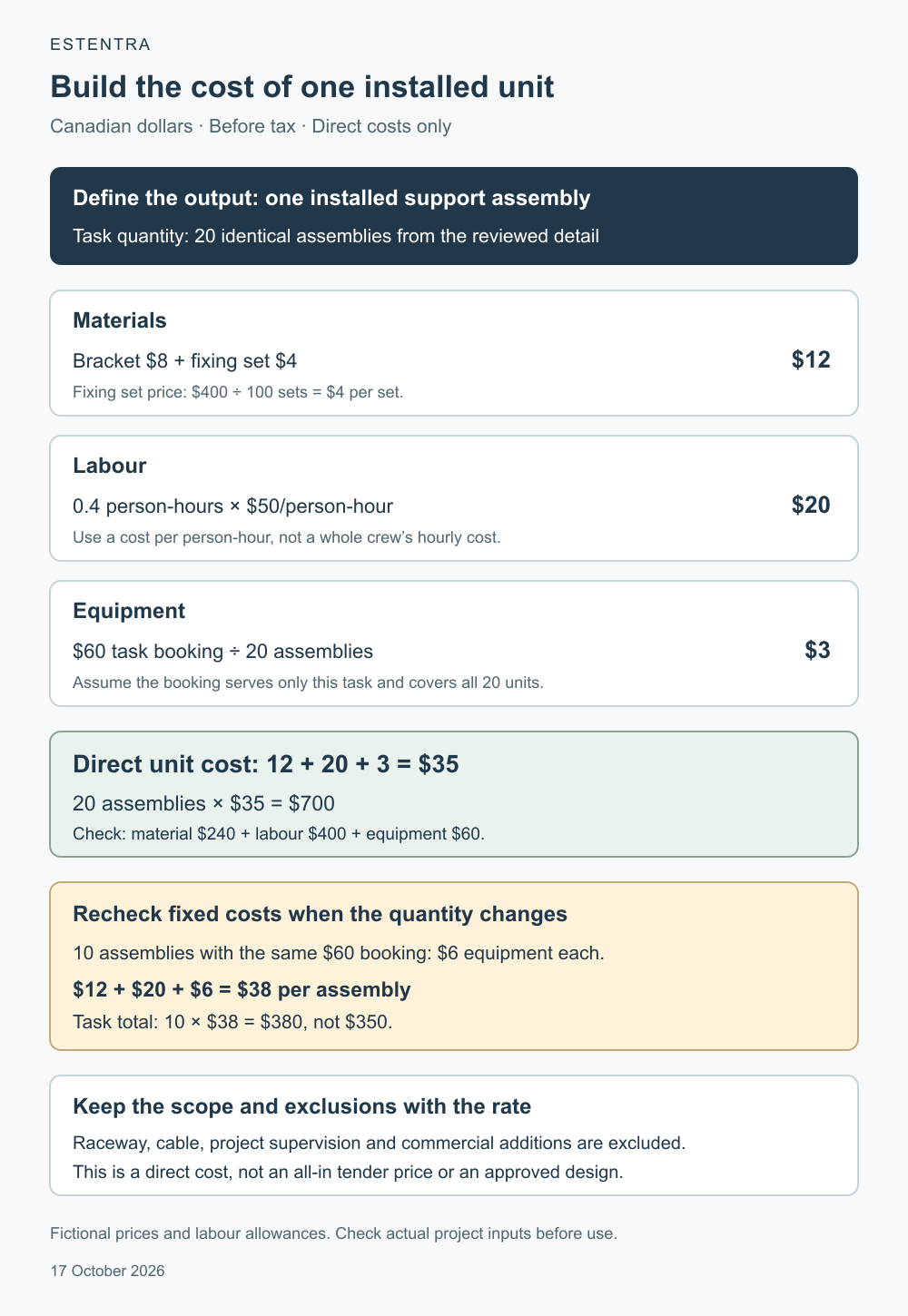
For a fixed task cost, divide that cost by the number of installed units it supports. If a booked day's equipment costs $60 and is used only for 20 assemblies completed during that booking, the allocation is $3 per assembly.
Record why the quantity and hire period are appropriate. If fewer assemblies are completed or another hire day is required, the allocation changes. If the equipment serves several tasks, allocate its cost consistently and check that the full charge is neither missed nor counted more than once.
Example: one installed support assembly
Consider a fictional task to supply and install 20 identical support assemblies from a reviewed project detail. Each assembly uses one bracket and one fixing set. The work includes mounting the assembly and checking its alignment. Raceway, cable, project supervision and commercial pricing additions are outside this example.
Assume the following inputs have been reviewed for this task:
- Brackets cost $8 each, including the delivery covered by the fictional quotation.
- Fixing sets are sold in the required quantity at $400 per 100 sets, or $4 per set. There is no compulsory 100-set pack in this example.
- The labour allowance is 0.4 person-hours per assembly and includes the task's setup and handling.
- The reviewed employer labour cost is $50 per person-hour. It is not a selling rate.
- Task-specific equipment costs $60 for one booked day, including all its hire charges for this example. All 20 assemblies are completed within that booking.
All amounts are fictional inputs in Canadian dollars before tax. They are not current prices, productivity benchmarks or an approved support design.
- Bracket — Calculation: 1 × $8 — Direct cost: $8
- Fixing set — Calculation: 1 × ($400 ÷ 100) — Direct cost: $4
- Labour — Calculation: 0.4 person-hours × $50/person-hour — Direct cost: $20
- Equipment — Calculation: $60 ÷ 20 assemblies — Direct cost: $3
- Direct unit cost — Calculation: 8 + 4 + 20 + 3 — Direct cost: $35 per assembly
For all 20 assemblies, 20 × $35 = $700. Check that total from the resources as well:
- Materials: 20 × $12 = $240.
- Labour: 20 × 0.4 = 8 person-hours; 8 × $50 = $400.
- Equipment: one booked day = $60.
- Task direct cost: $240 + $400 + $60 = $700.
The two calculations agree. You can trace the rate back to quantities, person-hours and the equipment booking instead of relying on an unexplained lump sum.
5. Check what changes when the quantity changes
Do not assume every cost scales in the same way. Material and labour may vary with the number of assemblies, while a minimum hire charge remains fixed.
If this fictional task falls to 10 assemblies, assume the material prices and labour allowance remain valid but the same $60 equipment booking is still required. Equipment now costs $6 per assembly. The direct unit cost becomes $12 + $20 + $6 = $38, and the task total is $380.
Multiplying the old $35 rate by ten would give $350 and miss $30 of the equipment allocation. On a real task, also recheck purchase terms, setup labour and working conditions rather than automatically holding them constant.
6. Keep direct cost separate from the selling price
The example's $35 rate is a direct unit cost for the stated work. It is not an all-in tender unit price or a statement of profit.
Record where project costs, overhead, risk provisions, profit and taxes are handled in the estimate. If something is already included in a supplier, subcontract or labour rate, check before adding it again. Follow the tender instructions when preparing a submitted unit price; it may need to include costs that this teaching example excludes.
Before reusing the rate
Keep the scope, output unit, quotations, labour basis, equipment allocation, exclusions and review date with the rate. Ontario MTO's February 2023 draft estimating guide calls for a traceable record of assumptions and decisions. [2] Apply that principle here: record why a stored rate is suitable and explain any changes.
Before applying a stored rate, check whether the work, quantity, conditions and input costs still match. A useful rate library preserves the reasoning behind the number so you can decide when it is suitable and what needs updating.
References
- Statistics Canada: Technical Guide for the Building Construction Price Index, 2023, Appendix A.2, “Representative cost components.” Published 6 June 2025. Supports the component-cost and quantity-extension principles; it is an index methodology, not a contractor rate book.
- Ontario Ministry of Transportation: Draft Cost Estimating Guide for Designers, February 2023, sections 6.1 and 6.3, printed pages 6–7. Supports documenting assumptions and estimate changes. The cover labels this document “Draft”; its context is ministry highway projects, not a general electrical-tender requirement.
References checked 18 October 2026. All example quantities, rates and conditions are fictional teaching inputs.
General estimating workflow guidance. Project requirements and contractual documents take precedence; this is not electrical design or code-compliance advice.