Estimating workflow
Electrical Labour Estimating: Hours and Composite Crew Rates
Calculate electrical labour costs using person-hours, crew-hours and weighted composite crew rates, with a worked example and checks for double counting.
7 min read
Keep person-hours, crew-hours and hourly costs on the same basis before multiplying them.
A three-person crew working together for one hour uses three person-hours. Its total cost for that hour is different from its average cost per person-hour. Confusing those two rates can multiply the labour estimate without adding any work.
Build the estimate in two parts: the person-hours needed for the task and the cost of those person-hours. Record who makes up the crew and how long each person is expected to participate.
1. Define the hours you are using
A person-hour is one person's work for one hour. Three people each working ten hours contribute 30 person-hours.
A crew-hour, as used in this article, means one hour worked by the defined crew. If all three members work together for ten hours, that is 10 crew-hours and 30 person-hours.
Write the crew size beside any crew-hour quantity. “Ten hours” alone could mean ten hours for one person, ten hours for the whole crew or the time allowed in the schedule. Those are different quantities.
If the crew changes during the task, record the different periods or each person's hours separately. Do not assume the same crew size and average cost apply throughout.
2. Establish the employer cost per person-hour
Use a reviewed hourly cost for each crew member or cost group. State what it includes: wages and the employer costs included in your estimate, such as applicable benefits and payroll costs. Estimators often call this the loaded hourly cost.
Record whether supervision, overtime premiums, travel and other allowances are included or priced separately. Keep company overhead and profit distinct from the employer labour cost unless your rate expressly includes them.
Use the costs and applicable employment arrangements for the intended work period. Do not copy a teaching example's hourly amount or burden percentage into a live estimate as a current rate.
Statistics Canada's labour-accounting notes distinguish wages from compensation that also includes employer benefit contributions. They calculate hourly compensation as total compensation divided by hours worked. [1] Those principles help explain the cost basis here; the notes do not set a contractor's payroll burden or crew rates.
3. Calculate the crew cost and its average
For a crew whose members all participate for the same hour:
- Multiply the number of people in each cost group by that group's hourly employer cost.
- Add those amounts to find the cost per crew-hour.
- Divide by the number of participating people to find the average cost per person-hour.
That average is the composite crew rate per person-hour. Keep the unit with the rate so it cannot be mistaken for the cost of the whole crew.
Example: a three-person crew
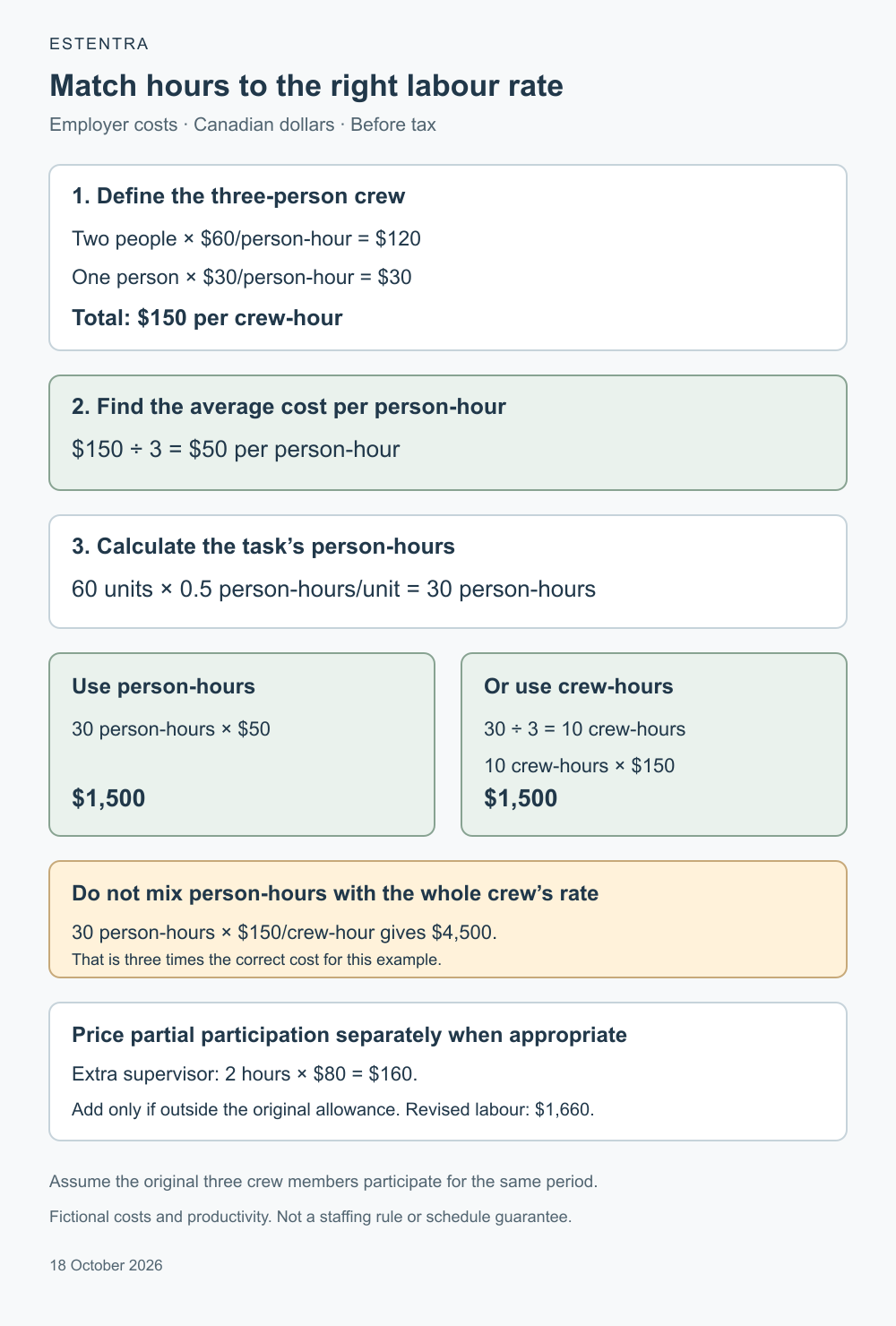
Consider a fictional crew with two people costing $60 per person-hour and one person costing $30 per person-hour. These amounts represent the employer costs included in this example, not pay rates, selling rates or a recommended staffing arrangement.
Assume all three work together for the same period, with no changes in rates or crew membership. All amounts are fictional costs in Canadian dollars before tax.
- Two people — Employer cost per person-hour: $60 each — Cost for one crew-hour: 2 × $60 = $120
- One person — Employer cost per person-hour: $30 — Cost for one crew-hour: 1 × $30 = $30
- Three people in total — Cost for one crew-hour: $150 per crew-hour
The composite rate is $150 ÷ 3 = $50 per person-hour.
Do not average the two listed cost amounts as (60 + 30) ÷ 2. That gives $45 and ignores the fact that two people cost $60 each. Weight the average by the people or person-hours actually represented.
4. Apply the rate to the task hours
Suppose a fictional installation task has 60 identical units, with a reviewed allowance of 0.5 person-hours per unit for the included work.
The task requires 60 × 0.5 = 30 person-hours. Using the example crew's composite rate:
30 person-hours × $50/person-hour = $1,500.
You can check the same cost using crew-hours. If the three-person crew can perform that work together on the stated basis, 30 person-hours ÷ 3 = 10 crew-hours. Then:
10 crew-hours × $150/crew-hour = $1,500.
Both calculations describe the same labour. Do not multiply 30 person-hours by $150 per crew-hour. That would give $4,500, three times the correct cost for the stated example.
The ten crew-hours are a planning result under these assumptions, not a promise of calendar duration. Check access, sequencing, setup, working hours and other constraints before using the hours to plan the schedule. Adding people does not, by itself, prove that the task will finish proportionally faster.
5. Account for people who participate for different periods
If someone attends for only part of the task, price that person's actual planned participation. A supervisor attending for two hours should not automatically be charged for every hour the installation crew works.
For example, if supervision is outside the original allowance and a supervisor is needed for two hours at a fictional employer cost of $80 per hour, add $160 separately. The example task's labour cost would become $1,660. Do not also include the same supervision in the composite rate.
If you need one average rate for a task with different participation periods, divide the total employer labour cost by the total person-hours represented. In this extended example, that is $1,660 over 32 person-hours, or $51.875 per person-hour before rounding. Keep the underlying hours and costs so the average can be checked. Do not apply it to a task with a different mix of people without reviewing it.
6. Check the labour allowance as carefully as the rate
A correctly calculated hourly cost does not prove that the number of hours is appropriate. Ontario MTO's February 2023 draft estimating guide also considers crew size, production rates and working time. [2] For this task, check:
- Its quantity basis: per item, metre, 100 metres or another stated amount.
- Whether it represents person-hours or crew-hours.
- The tasks it includes, such as handling, setup, installation or testing.
- The conditions it assumes, including access and installation difficulty.
- Whether a project adjustment covers a difficulty already included in the selected labour unit.
For example, if a labour allowance is already selected for restricted access, do not add another restricted-access factor without checking what extra effect it represents. Record the reason for an adjustment rather than applying an unexplained percentage.
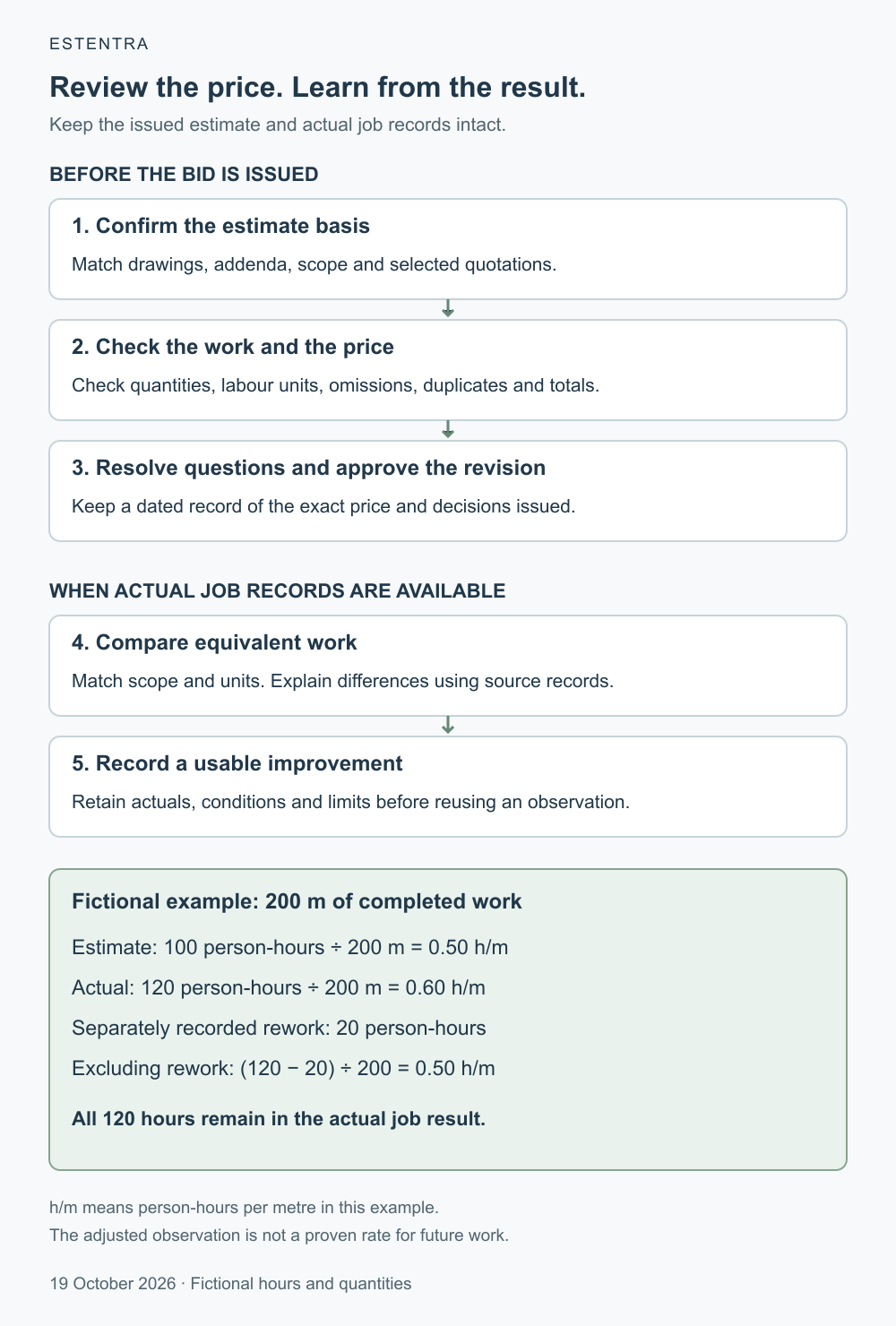
Compare the allowance with completed work that has similar scope and conditions where records are available. Keep disruption, rework and changed scope visible so they do not become unexplained productivity assumptions for the next project.
Before using the labour total
Check that the estimated quantity and labour-unit denominator match, that the hours and cost rate use the same basis, and that the crew's participation is recorded. Show any separately priced supervision, premiums or travel once.
Another estimator should be able to follow the calculation from the task quantity to person-hours, crew composition and total cost. A composite rate is useful because it summarises that record; it should not replace it.
References
- Statistics Canada: Canadian Quarterly Labour Productivity Accounts — Technical Notes: a revised version — 2021, “Total labour compensation and unit labour cost.” Supports the distinction between wages and broader compensation, and the total-cost/total-hours basis. It does not supply project crew rates.
- Ontario Ministry of Transportation: Draft Cost Estimating Guide for Designers, February 2023, sections 8.6 and 12, printed pages 13–14 and 20–21. Construction-estimating context only; the cover labels the document “Draft.”
References checked 18 October 2026. All costs, crew arrangements, quantities and labour allowances in the examples are fictional teaching inputs.
General estimating workflow guidance. Project requirements and contractual documents take precedence; this is not electrical design or code-compliance advice.