Estimating workflow
Electrical Scope Review: What to Check Before Takeoff
Review electrical scope before takeoff. Clarify supply, installation and testing responsibilities, document exclusions and resolve gaps in the estimate.
7 min read
Define the work, responsibilities and unresolved questions before turning drawings into quantities.
A drawing shows a generator. A supplier sends a generator quotation. Neither, by itself, tells you everything that belongs in the electrical estimate.
Who provides the concrete pad? Who installs the fuel and exhaust connections? Who unloads and positions the generator? Who installs the electrical connections and performs the required tests? If these responsibilities are unclear, the estimate may leave out work even when the measured quantities are correct.
Scope review identifies the work included in your price, the work assigned to others and the questions that still need answers. Project intake gathers the documents and project details. Scope review uses them to identify the specific work you need to measure and price.
1. Read all documents that describe the work
Use the current drawings, specifications, schedules, tender instructions and addenda together. For each scope decision, record the drawing number and revision, specification section or addendum that supports it.
For each system, look beyond the equipment symbol or schedule entry. Check for removal of existing work, temporary power, access equipment, supports, connections, testing, operator training and required handover documents. Include the requirements that apply to this project rather than copying a standard list into the price.
Read the relevant mechanical, architectural and civil documents as well. Check who supplies equipment that needs electrical connections, who provides openings for cables or raceways, and who supplies and connects control wiring.
NRC's National Master Specification development guide recognises that a complete system may be described across related sections and calls for coordination between them. It also states that master specifications must be edited to suit the project. Use an old specification or estimate to identify items to check, then confirm the current requirements in the tender documents. [1]
If documents disagree, record both references and ask for clarification through the route stated in the tender. Check whether the tender says which document takes priority. Do not assume that drawings or specifications always take precedence.
2. Describe work that can be measured and priced
A scope note should identify the system, location, work and supporting reference. Compare these entries:
- Generator work — More useful estimating description: Connect the new generator to the transfer switch, including the power and control work identified on the referenced drawings.
- Lighting — More useful estimating description: Remove the existing fixtures in the identified rooms and install the scheduled replacements, including the specified control changes.
- Testing — More useful estimating description: Include the labour, specialist attendance, reports and return visits required for the tests listed in the project specifications.
These examples show how to write a scope note. Add the actual drawing references, quantities, locations and limits of the work for your project.
Link each scope note to the relevant measured item, request for a supplier quotation, subcontract quotation or separate cost in the estimate.
3. Separate supply, installation and testing
For each work item, identify who supplies it, who installs or connects it, and who performs the required testing or verification. Record the evidence for each responsibility.
Use separate work items when different parties are responsible. For a generator, list equipment supply, unloading, positioning, wiring and startup separately, then name the responsible party for each.
Read supplier quotations with the same care. If a quotation lists equipment supply and vendor startup, check separately whether it includes unloading, positioning, site wiring and the other required tests. Compare each quoted item with the project requirements.
Use the responsibility diagram to identify work with no confirmed responsible party. Ask who will do that work before deciding to leave it out of your price.
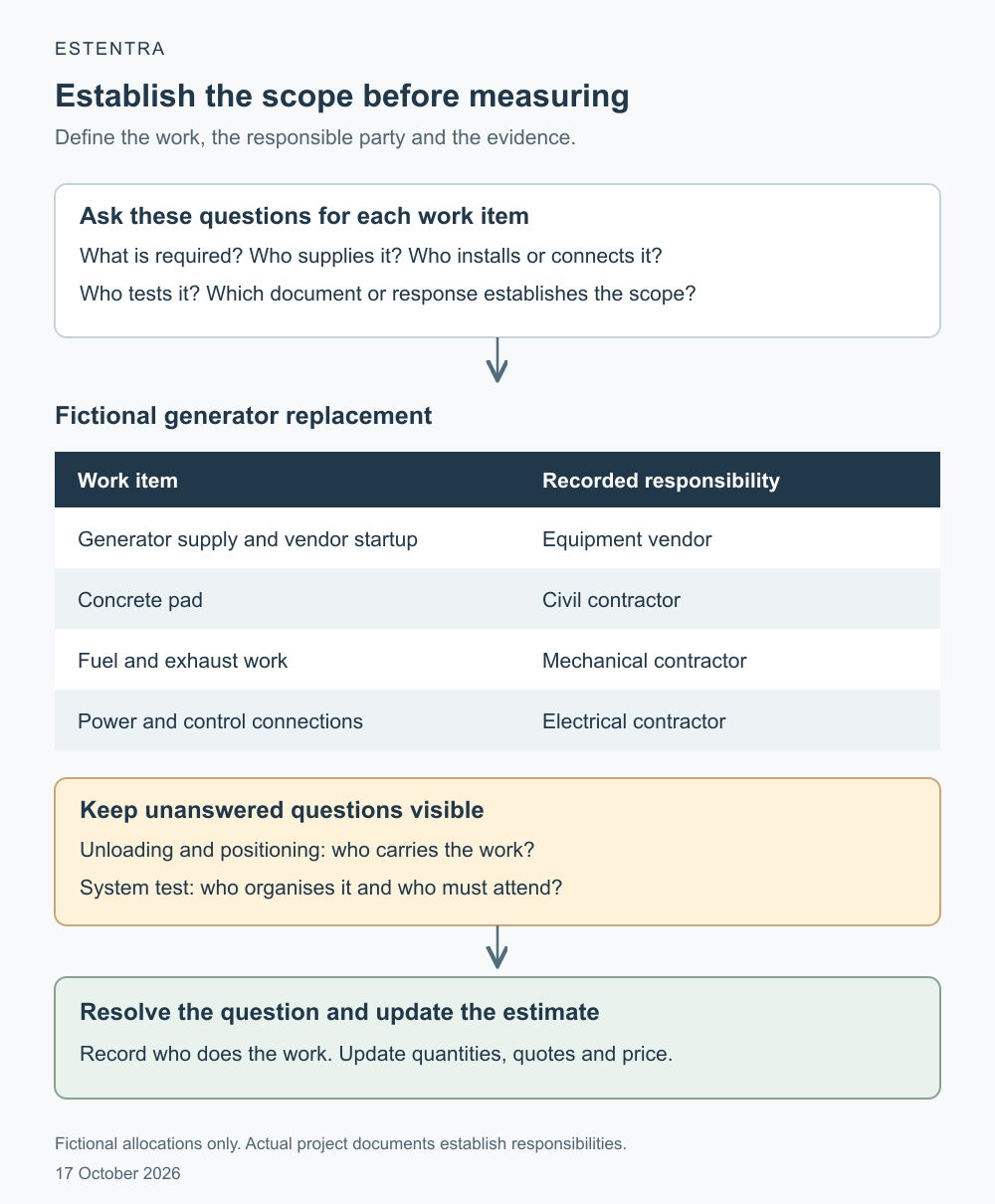
Example: a generator replacement
Consider a fictional tender with these stated responsibilities:
- Generator supply and vendor startup — Responsibility stated in the fictional documents: Equipment vendor — What the estimator includes or checks: Check that the quotation includes the specified equipment and required vendor startup services.
- Concrete pad — Responsibility stated in the fictional documents: Civil contractor — What the estimator includes or checks: Record the document assigning the pad to civil before leaving its cost out of the electrical estimate.
- Fuel and exhaust work — Responsibility stated in the fictional documents: Mechanical contractor — What the estimator includes or checks: Check whether fuel-system or exhaust equipment needs power or control connections included in the electrical work.
- Power and control connections — Responsibility stated in the fictional documents: Electrical contractor — What the estimator includes or checks: Measure and price the specified electrical work.
- Unloading and positioning — Responsibility stated in the fictional documents: Not assigned clearly — What the estimator includes or checks: Ask who unloads and positions the generator and who provides the lifting equipment.
- Coordination of the specified system test — Responsibility stated in the fictional documents: Not assigned clearly — What the estimator includes or checks: Ask who organises the test, who must attend and what each party must do.
The electrical estimator can begin measuring the confirmed power and control connections while clarifying who will unload and position the generator and who will coordinate and attend the system test. Assign each question to a named person and record when the answer is needed. Before finalising the price, confirm who will do the work and how it will be priced. If an answer is still missing, have the person authorised to approve the estimate decide what to include and record that decision in line with the tender instructions.
These responsibilities are assigned only for this fictional example. Confirm them from the documents on each real project. The example includes both vendor startup and a separate system test, so both must be considered.
4. Keep exclusions, assumptions and allowances distinct
Use precise language when information is incomplete:
- An exclusion identifies work left out of your price. State exactly what is excluded and why.
- An assumption records a condition you have used to prepare the price. For example, the estimate may assume access during the working hours stated in the tender.
- An allowance includes a stated amount or quantity for work that is identified but not yet fully defined. Record the work it covers and how you determined the amount or quantity.
- An open question identifies information you still need before deciding what work or cost to include.
Use these definitions in your estimate notes unless the tender defines the terms differently. Follow the tender's pricing instructions. State whether an allowance is required by the tender or is an amount you have included internally for estimating purposes. Keep the submitted bid in the required format.
Describe exactly what each allowance covers and what information is still missing. For example, an allowance for generator positioning should say whether it includes lifting equipment, labour or both. Check that those costs are not already included elsewhere in the estimate.
5. Update the estimate when an answer arrives
When a clarification or addendum arrives, identify which work items it changes. Record the new reference, who is responsible and what must be included in the price. Update the affected quantities, labour, quotations and other costs.
For example, if a revised instruction assigns generator positioning to the electrical contractor, check the lifting equipment, labour and any specialist quotation needed to do that work. Add the applicable costs to the estimate. Saving the response alone does not update the price.
Procurement Assistance Canada directs federal bidders to monitor amendments and follow the solicitation's requirements. That guidance applies to federal opportunities. For your project, follow the stated rules for asking questions, declaring exclusions or assumptions, and submitting the bid. [2]
Before measuring
Ask whether another estimator could read your scope notes and identify the work to measure, the work assigned elsewhere and the questions still open. For work assigned to others, record the document or written clarification that confirms the assignment.
Begin measuring the work that is clearly defined and assigned to your estimate. Keep a list of unanswered questions and review their effect on the price before issuing the bid. Check both that the quantities are correct and that all required work has been included.
References
- National Research Council Canada: NMS development guide, sections 1.3 and 3.2.3, concerning project adaptation and related specification sections.
- Procurement Assistance Canada: Preparing to bid on an opportunity, “Review and understand an opportunity.” Federal procurement context.
References checked 17 October 2026. The workflow, writing examples and generator scenario are original educational guidance.
General estimating workflow guidance. Project requirements and contractual documents take precedence; this is not electrical design or code-compliance advice.