Estimating workflow
Electrical Estimate Intake: What to Check Before Takeoff
Start an electrical estimate with a project intake checklist covering tender deadlines, document revisions, scope responsibilities and unanswered questions.
6 min read
A practical way to establish the project, document basis and unresolved responsibilities before takeoff starts.
An electrical estimate can be wrong before the first quantity is measured. The drawings may be an old issue. An owner-supplied item may still need installation labour. A shutdown may require a separate visit that never reaches the price.
A project intake brings these questions into one short record. Its purpose is to establish what information you have, what work needs review and what must be clarified before the estimate progresses. Start it when the enquiry arrives and update it as the tender changes.
1. Confirm the project and tender instructions
Record the project name, location, tender number, client, general contractor or bid recipients, electrical consultant and estimator. Include the estimate revision so the intake can be matched to the correct price.
Then record the instructions that control your estimating schedule:
- Tender closing date and time, with the source of that instruction.
- Your internal deadline or the deadline for sending a quote to a general contractor.
- Submission method, destination and required forms.
- Deadline and permitted route for questions.
- Site visits, access arrangements and other requirements that need action before closing.
- Expected construction period, phasing and permitted working hours.
Keep the recipient's deadline separate from your own review deadline. When an addendum changes closing, record the revised instruction and its reference rather than replacing a date without explanation.
For federal opportunities, Procurement Assistance Canada specifically directs bidders to check closing instructions, submission methods, pre-closing requirements and amendments. Use the actual tender instructions for the project you are pricing. [1]
2. Establish the document basis
List the drawings, specifications, schedules, tender instructions and addenda you have received. Record their identifiers, revisions, issue dates and file locations. Check them against the issuer's document list or tender portal where available, and flag missing documents.
Read the electrical information alongside the relevant architectural, mechanical and civil information. Look for interfaces such as equipment connections, access panels, trench reinstatement and controls. Record discrepancies and send questions through the specified tender route.
Keep this record specific to the project. A master specification or an old estimate can help you identify questions, but it cannot establish the requirements of the current tender. NRC makes the same project-specific distinction for the National Master Specification: it requires adaptation and does not replace the project's specifications. [2]
3. Review systems and responsibilities
Work through the systems that may affect your price: lighting and controls, distribution, feeders, mechanical connections, temporary power, generators and transfer equipment, fire alarm, communications, security, grounding, civil interfaces and closeout. Add other systems shown in the project documents.
For each item, record whether it is included in the estimate, excluded, carried as an allowance, unknown or not applicable. Then name the parties responsible for supply, installation or connection, and testing or commissioning. Where a system has different responsibilities, split it into separate work items.
Use clear entries:
- Included — Meaning in the intake: Carry the described work in this estimate.
- Excluded — Meaning in the intake: Leave the described work out, with a recorded basis and any required tender qualification.
- Allowance — Meaning in the intake: Carry a stated amount or quantity for defined unresolved scope, with its basis.
- Unknown — Meaning in the intake: The information or decision is still missing. Assign an action.
- Not applicable — Meaning in the intake: The item does not apply to this project. Record why.
These are estimating-record conventions. An intake entry does not change the tender requirements or make an otherwise prohibited qualification acceptable.
Replace a vague “approved” entry with the actual status and evidence. “Supplier confirmed against addendum 02” tells the next estimator more than an unexplained tick. It also keeps intake review separate from product approval and design review.
4. Record the conditions that affect the work
Review working heights, access equipment, occupied areas, permitted hours, outages, temporary continuity, unloading and storage. Identify specialist visits, utility coordination, permits, fees and testing requirements that need confirmation.
Record each condition where it can influence the estimate. For example, a restricted shutdown window may affect the installation sequence, crew plan or number of visits. Confirm the actual restriction before selecting an allowance or labour adjustment.
Treat the intake as a prompt to investigate. The presence of “infrared scanning” or “seismic study” on a checklist does not establish that the project requires it. Use the project requirements and appropriate technical review to determine the scope.
5. Give every unresolved question a next step
For each open question, record an action ID, the affected scope, an action owner, a response due date and the possible estimate impact. Link the written response when it arrives, then record what changed in the takeoff, quotation or pricing basis.
A reply alone does not show that the estimate was updated. Close the action after its effect has been dealt with. If an uncertainty remains, have the authorized estimating reviewer decide whether to hold the affected work or proceed with a recorded condition. Revisit those conditions before submitting the bid.
For federal tenders, CanadaBuys directs bidders to use the specified question process and observe its timelines. Other clients may use a different route; follow the instructions for that tender. [3]
Example: owner-supplied lighting
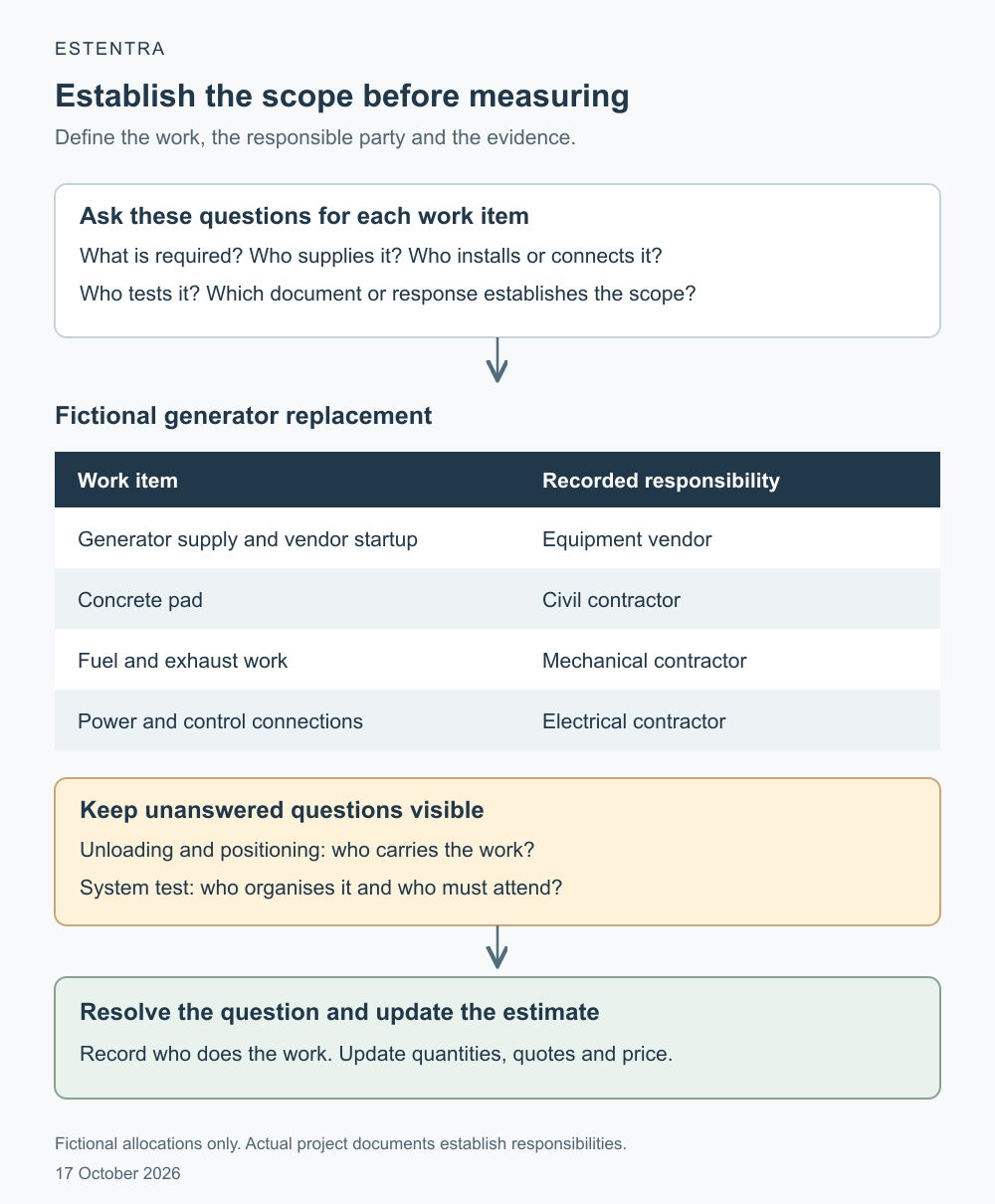
Consider a fictional renovation with 24 replacement luminaires. Drawing E-201, revision 1, note 7 assigns luminaire purchasing to the owner. The fictional specification assigns installation, branch wiring, controls and testing to the electrical contractor. Unloading, storage and damage arrangements are not stated.
The intake should preserve those distinctions:
- Luminaire purchase — Intake entry: Excluded from the electrical purchase price; supplied by owner — Next step: Retain the drawing-note reference.
- Installation, wiring, controls and testing — Intake entry: Included under the fictional specification — Next step: Carry the relevant quantities and labour.
- Unloading, storage and damage arrangements — Intake entry: Unknown — Next step: Assign Q01 to the estimator for written clarification.
Removing a complete lighting assembly from the estimate would also remove work expressly assigned to the electrical contractor in this example. Separate the purchase component, keep the installation scope visible and resolve the handling question.
6. Review the intake before takeoff proceeds
Have the estimator or estimating lead review the document basis, scope entries and open actions. Record one decision: hold for clarification, proceed with recorded conditions, or proceed. Name the reviewer, date the decision and identify any conditions.
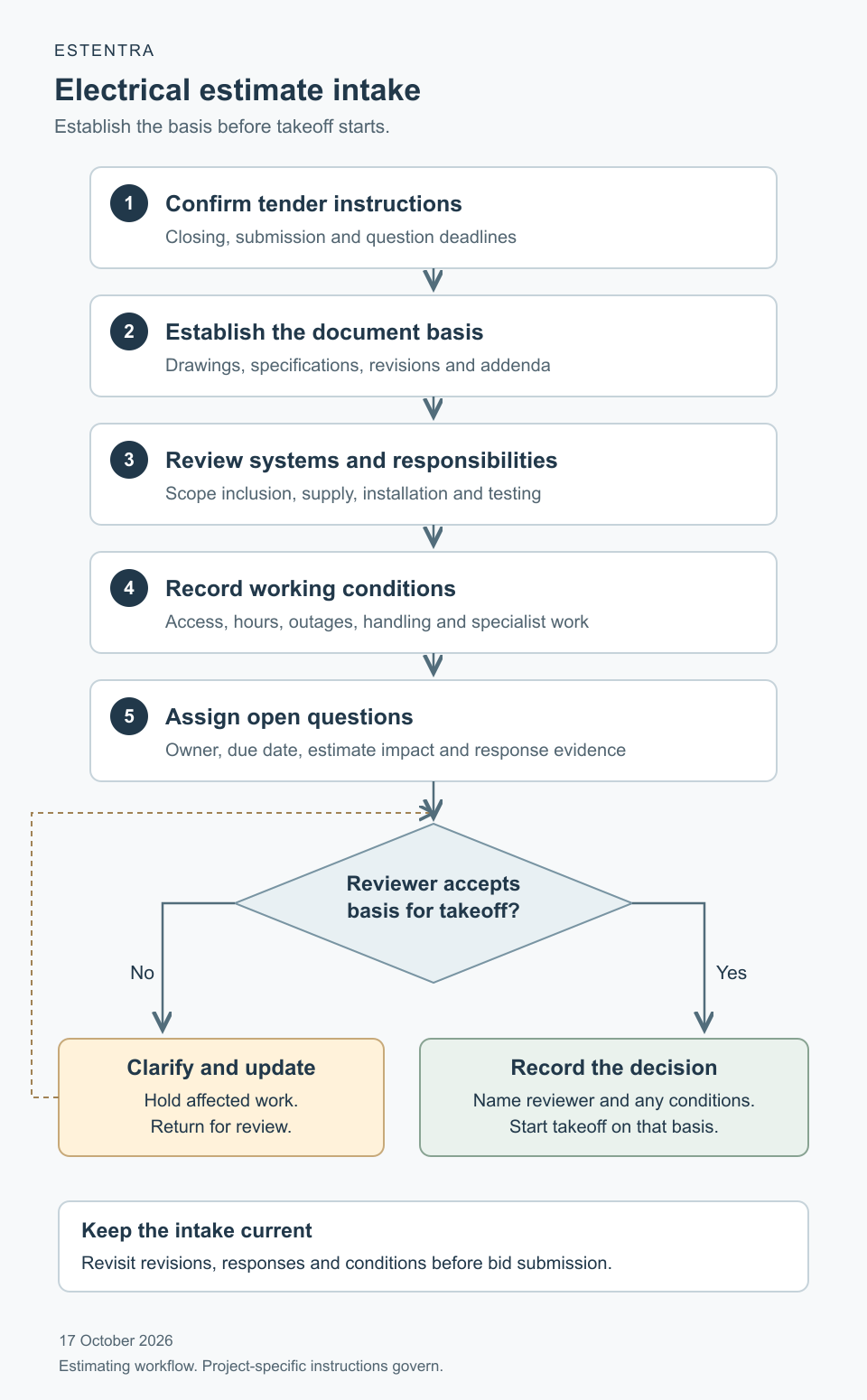
Use the intake workflow diagram to follow that sequence. Keep the project information, system responsibilities, document revisions, addenda and open questions with your estimate notes. The intake records decisions; it does not calculate the estimate or automatically certify that the information is complete.
Keep the intake with the estimate and revisit it when documents, scope or working conditions change.
References
- Procurement Assistance Canada: Preparing to bid on an opportunity, “Review and understand an opportunity” and “Prepare your bid document.” Federal procurement context.
- National Research Council Canada: NMS development guide, section 1.3, “Limitations of use.”
- CanadaBuys: Checklist for preparing a bid, “Submit questions.” Federal procurement context.
References checked 17 October 2026. The workflow, status conventions and fictional example are original editorial guidance.
General estimating workflow guidance. Project requirements and contractual documents take precedence; this is not electrical design or code-compliance advice.