Estimating workflow
Review the estimate and improve the next one
Check scope, quantities, quotations and the bid total before issue, then compare recorded job results without hiding rework.
6 min read
Check the price before it leaves the office, then use recorded job results to improve future estimates.
An estimate can add up correctly and still miss required work. A supplier quote may cover an older drawing. Installation labour may be included twice. An unanswered scope question may disappear from the final summary.
A review should check what the price covers and how it was built. After the work, compare the estimate with recorded quantities, hours and costs. Keep the original estimate and the actual result intact so the comparison explains what happened.
1. Identify the exact estimate being reviewed
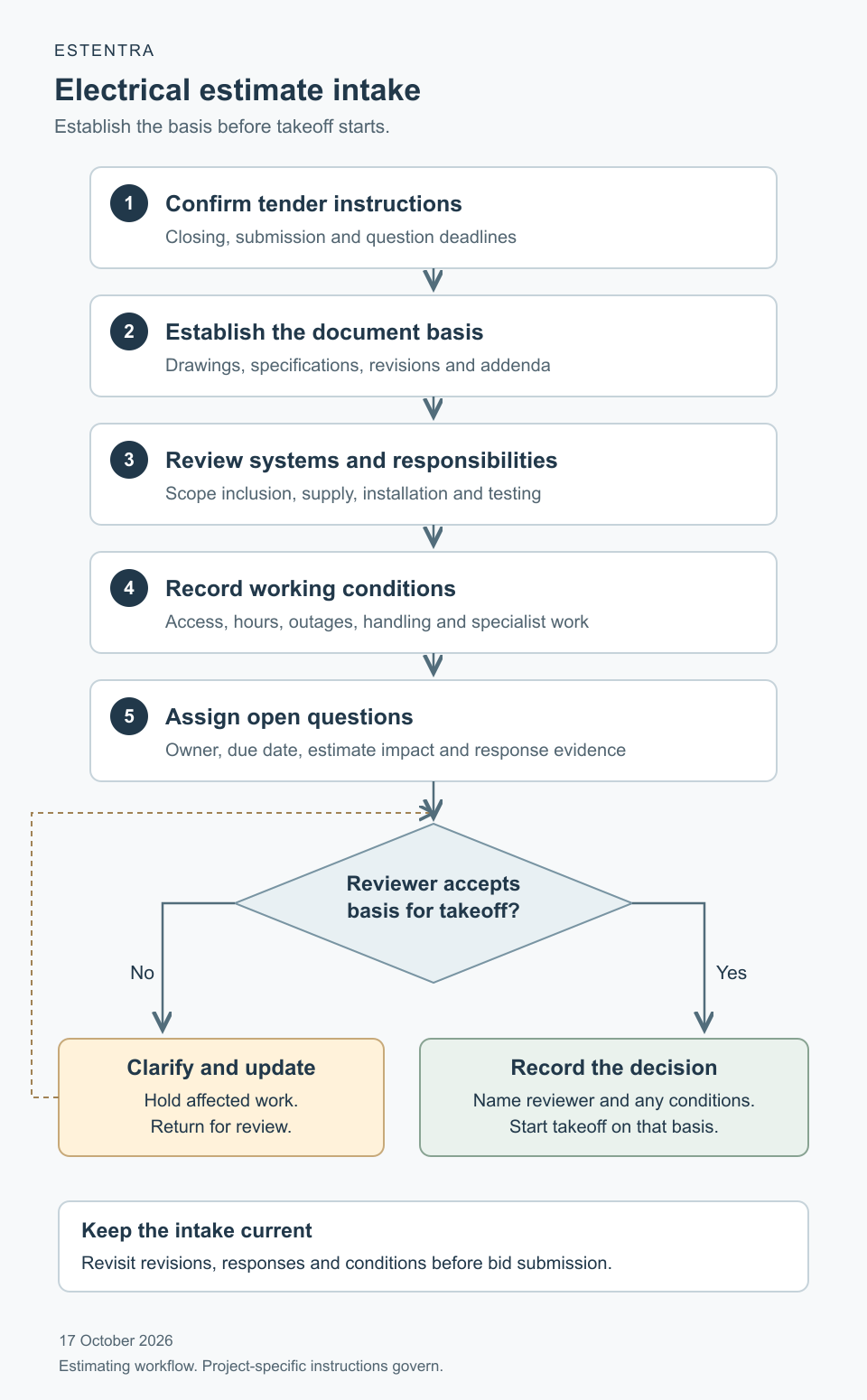
Give the reviewer the estimate revision, drawing and specification register, addenda, selected quotations and outstanding questions. Identify the submission deadline, required forms and person authorised to approve the price.
Check that these records describe the same work. If a quotation excludes a revised item, do not assume the change is covered because the quotation is attached to the latest estimate.
British Columbia’s December 2020 Project Cost Estimating Guidelines identify complete scope, documented assumptions, updates when information changes and appropriate approval as parts of its estimating policy. [1] That guidance applies to the ministry’s transportation projects; it is a useful reference for these principles, not a mandatory procedure for every electrical tender.
Keep a dated copy of the reviewed estimate. If the price changes afterwards, identify the changed items and have the appropriate reviewer check them before issue.
2. Check the work, the calculations and the submission
Follow the price from the project documents to the tender form. Concentrate on the work that is costly, uncertain or easy to omit, while still reconciling the complete summary.
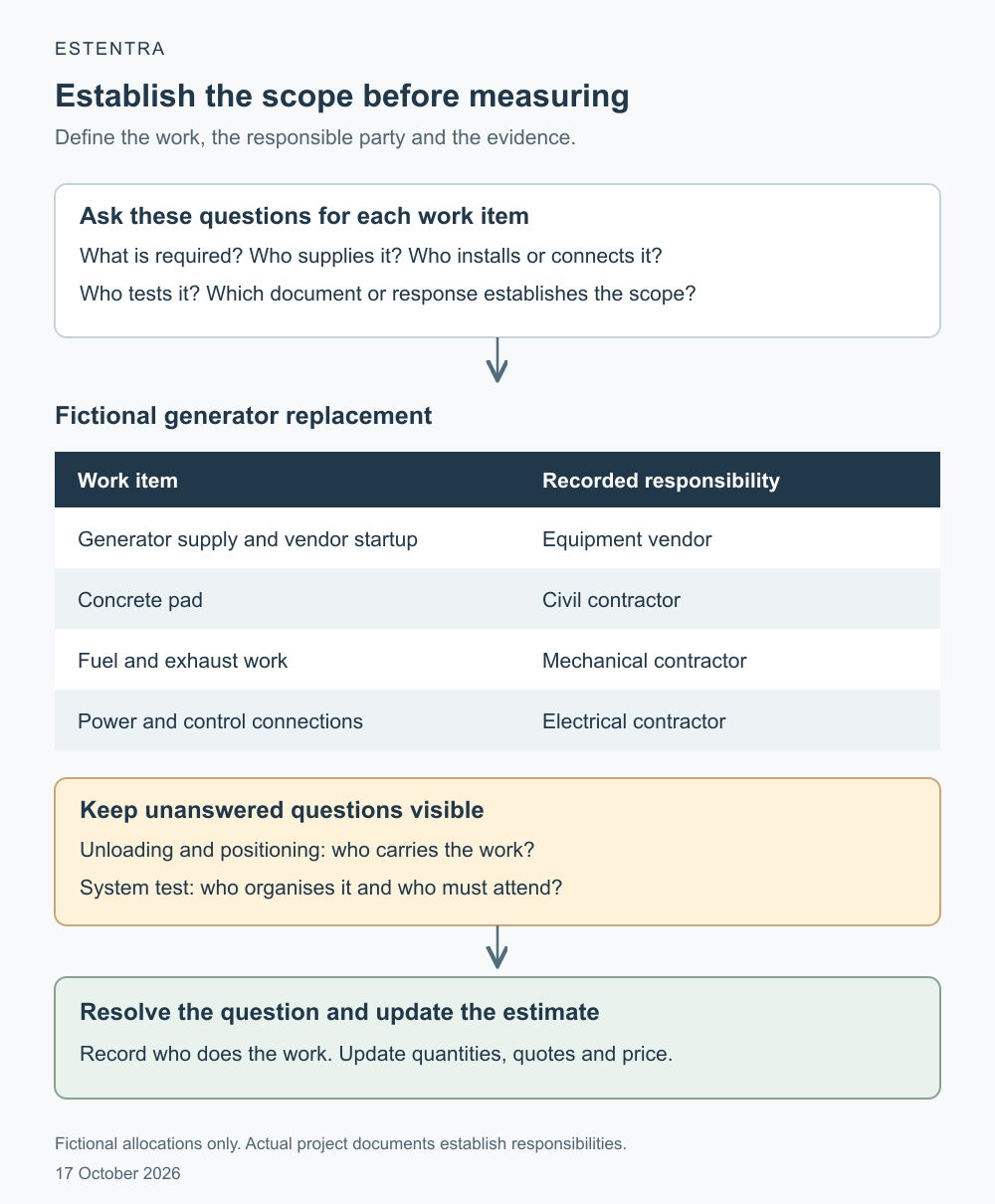
- Scope: check required supply, installation, testing, temporary work and responsibilities against the project documents. Record exclusions and unresolved questions.
- Quantities: check drawing revisions, units, major counts and calculations. Keep measured work separate from purchasing allowances and order rounding.
- Labour: check what each allowance covers and whether rates use person-hours or crew-hours. Review access, shutdowns, supervision and other project conditions.
- Quotations: check the selected revision, included work, exclusions, validity and delivery. Confirm separately priced work has not also been included elsewhere.
- Price summary: reconcile material, labour, equipment, subcontract and other costs. Check the base for each percentage, the tax presentation, rounding and amounts copied to the submission form.
Ask another suitably experienced estimator to review important or uncertain items where practical. Give them the supporting documents so they can challenge the assumptions and repeat key calculations.
A check mark alone does not explain the review. Record what was checked, the finding, who checked it and what changed. For an unanswered question, identify the person responsible and the answer needed before submission. Resolve it or obtain an authorised estimating decision consistent with the tender instructions. Do not describe an assumption as a confirmed scope agreement.
3. Preserve the bid basis before comparing actual results
Keep the estimate that supported the issued bid. Record later design changes, additional work and revised forecasts separately. Otherwise, changing the original estimate to match the job makes it impossible to see what the bid predicted.
When job records are available, compare equivalent work. Check that the estimate and actual records use the same item description, unit, quantity limits and included tasks.
Separate differences you can support with records: changed quantities, added scope, material prices, labour hours, rework or unusual access conditions. Do not assign a cause simply because it seems likely. If time records combine installation and other work, say that the hours cannot yet be separated reliably.
An ESDC audit described variance analysis and lessons learned at project closure, but found no evidence in its sampled projects that the lessons were used to improve costing practices. [2] This is a federal departmental example. The practical lesson here is to turn a recorded finding into a specific estimating change, then check whether that change remains appropriate on the next job.
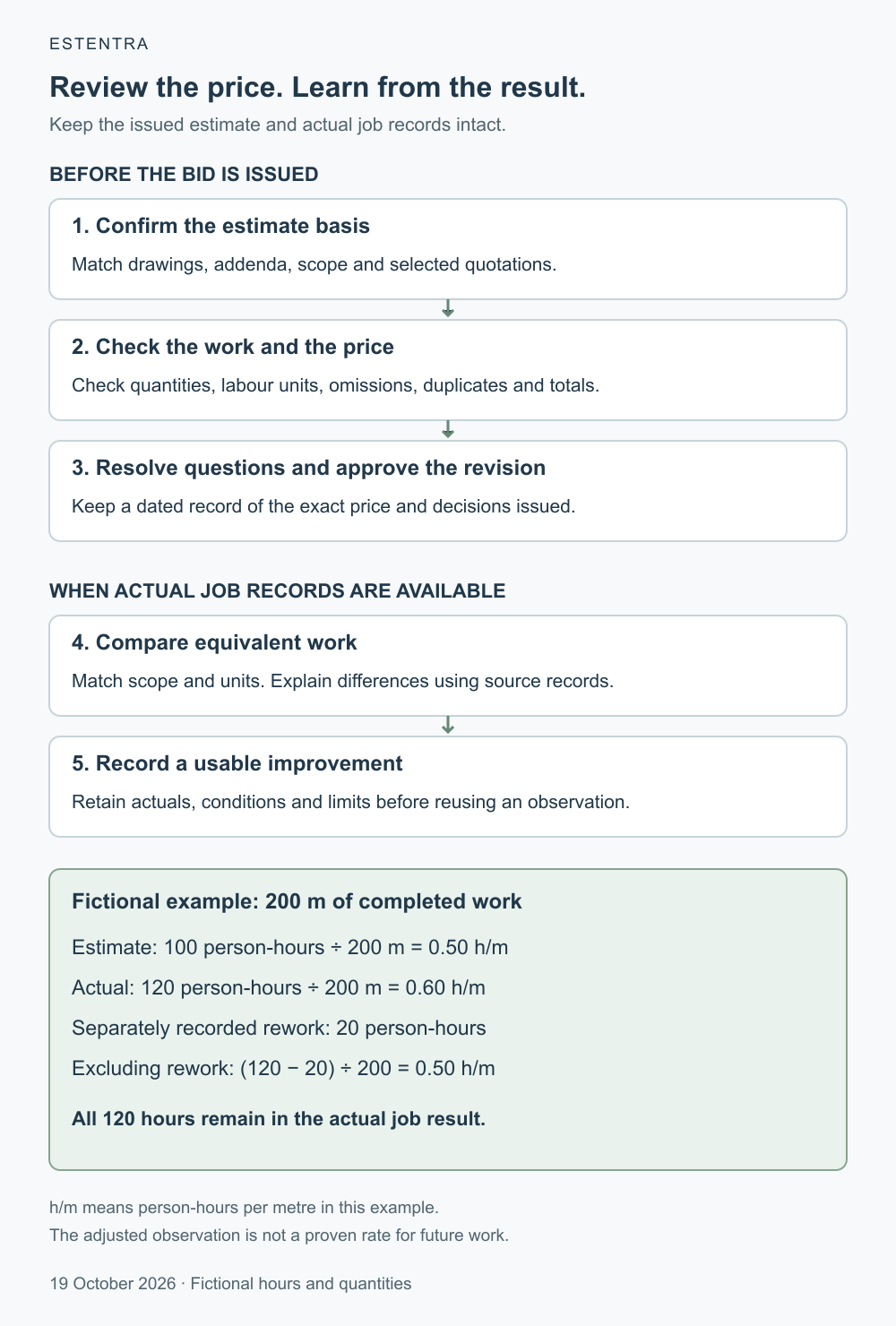
Example: retain rework in the actual hours
Assume a fictional cable-installation activity was estimated at 100 person-hours for 200 m, including its stated handling and installation tasks. Completed quantity records confirm the same 200 m. Time records show 120 person-hours, of which 20 person-hours are separately supported as rework. Assume no scope change for this example.
| Observation | Calculation | Result |
|---|---|---|
| Original estimate | 100 person-hours ÷ 200 m | 0.50 person-hours/m |
| Actual result, including rework | 120 person-hours ÷ 200 m | 0.60 person-hours/m |
| Recorded rework | Separately identified time | 20 person-hours |
| Observation excluding recorded rework | (120 − 20) ÷ 200 m | 0.50 person-hours/m |
The activity used 20 more person-hours than estimated, or 20% more than the original 100-hour allowance. All 120 hours remain part of the actual result. Subtracting rework for a separate comparison does not remove its cost from the job.
The 0.50 figure excluding rework is a limited observation from this activity. It is not a proven normal rate or a reason to assume future work will have no rework. Check the installation method, crew, handling, access and included tasks before considering it for another estimate.
Investigate what the rework records actually establish. If they identify a preventable document error, the improvement might be a drawing-revision check before installation. That is different from reducing every future labour allowance by 20 hours.
4. Turn the finding into usable estimating evidence
Keep the actual result and any separately adjusted comparison together. Record the project date, location, work description, measured output, crew information, included tasks, site conditions and source records. State what was excluded from the comparison and why.
Have the responsible reviewer decide whether the observation is suitable for the company’s estimating library. If it is, record the conditions under which it may be used. Keep earlier observations so one unusually good or poor result does not silently replace the evidence.
For a future task, choose comparable evidence and explain any adjustment. A different quantity, installation method or access condition may need a different allowance. Where records are incomplete, keep the result as a question to investigate rather than turning it into a precise rate.
Before closing the review
The bid review should leave a traceable price, recorded decisions and approval of the exact revision being issued. The job review should leave an honest actual result, an explanation supported by records and a specific improvement for future work.
Keep both. Finding an estimating error helps the next bid only when the correction reaches the process or data used to prepare it.
References
- British Columbia Ministry of Transportation and Infrastructure: Project Cost Estimating Guidelines, December 2020, section 1.0, printed page 1. Transportation-project policy context.
- Employment and Social Development Canada: Audit of costing practices, “Project costing at ESDC” and section 2.2, “Lessons learned.” Historical departmental audit findings, not a claim about every contractor or current departmental practice.
References checked 19 October 2026. The review workflow and numerical example are original educational guidance. All quantities and hours are fictional; no productivity benchmark or recommended labour allowance is supplied.
General estimating workflow guidance. Project requirements and contractual documents take precedence; this is not electrical design or code-compliance advice.