Electrical Systems & Specifications
Communications Systems Under Division 27
Understand Division 27 infrastructure, data, voice, audiovisual and specialist communications systems, with practical checks for a complete estimate.
10 min read
Understand the infrastructure, equipment and specialist systems behind a communications installation, then check what is needed to make each one complete.
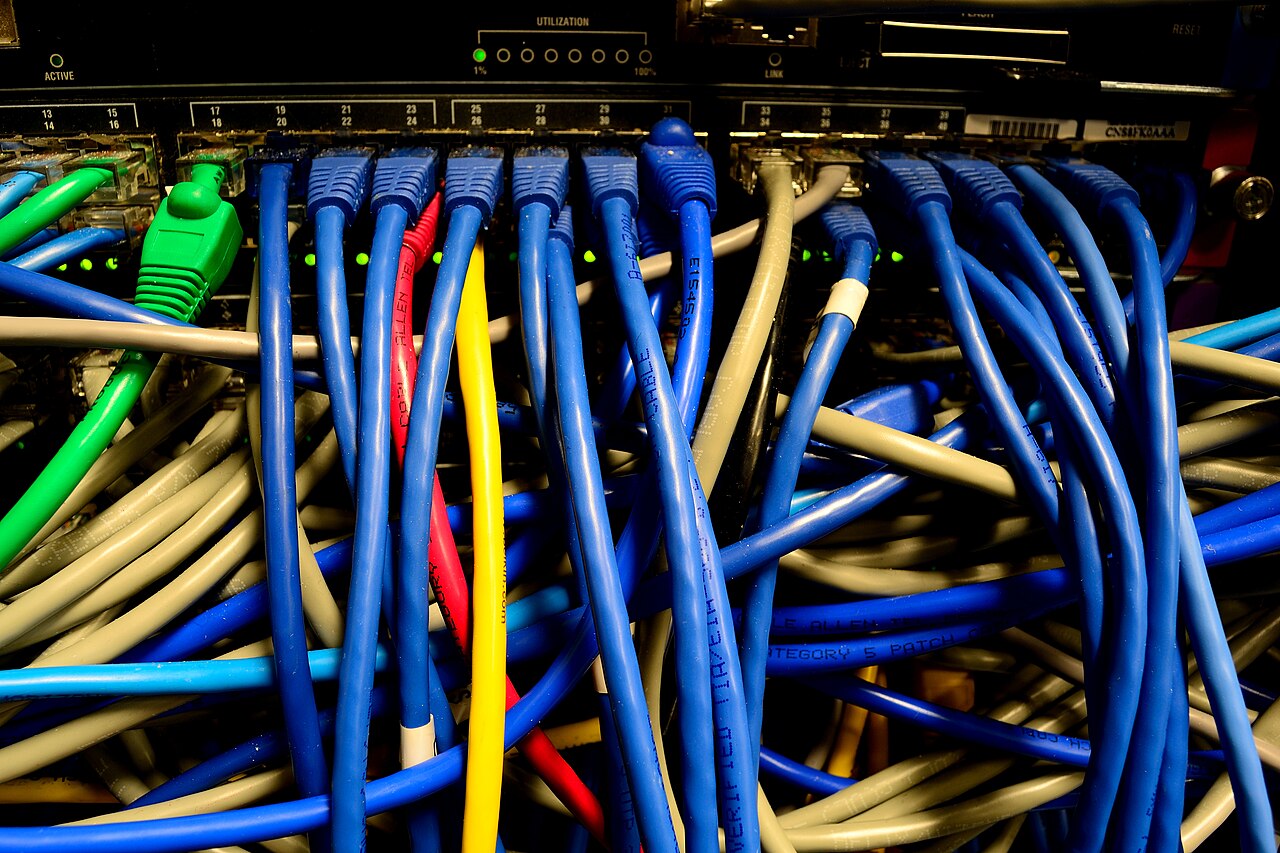
Network equipment is one part of a communications installation. Photograph: Raysonho, CC0. The image is illustrative, not a recommended cable arrangement.
A drawing marked “communications” can include data outlets, wireless access points, telephones, speakers, displays and patient-call devices. These items do not all perform the same job, and a quotation for data cable will not necessarily cover them all.
Division 27 organises communications work. It extends beyond structured cabling to systems that carry information, speech, images and calls. This guide explains the main groups and the questions an estimator should resolve before pricing them. The project's specification index, drawings and tender instructions establish the actual scope.
1. Separate infrastructure from an operating system
Start by identifying two related parts of the work:
- Infrastructure: rooms, racks, pathways, cabling, terminations, bonding and identification that support the installation.
- Equipment and system operation: the specified devices, power arrangements, software, configuration, testing and handover needed for the required function.
The first part can be complete while the second remains unfinished. A tested data cable does not, by itself, provide an active network connection, an operating telephone or a working audiovisual system.
Nova Scotia's 2024 Government Structured Cabling Guidelines address communications spaces, backbone and horizontal cabling, bonding, identification, testing and documentation. [1] They illustrate the breadth of infrastructure work. Their particular requirements apply within their stated scope; they are not default requirements for every Canadian project.
2. Recognise the main systems
| System or work group | What it provides | What to establish before pricing |
|---|---|---|
| Structured cabling | Organised copper or optical-fibre connections, with termination and patching components. | Which links, cable types, connectors, patching, tests and records are required? |
| Data and wireless networks | Active equipment connects network devices; wireless access points provide radio connectivity to compatible user devices. | Who supplies and installs switches and access points, provides power, and configures the network? |
| Telephone and voice communications | The specified telephone equipment and supporting connections carry voice calls. | Does the package cover cabling only, or also equipment, service coordination and configuration? |
| Audiovisual systems | Displays, projection, sound and conferencing equipment support presentations and communication. | Are mounting, power, data, pathways, control programming and demonstrations included? |
| Paging, public address and intercom | Announcements are distributed to the specified areas, or people communicate between locations. | Which speakers, stations, head-end equipment, zones, connections and setup are required? |
| Healthcare communications | Nurse-call and related installations communicate requests for assistance and other specified information. | Which room devices, call indications, interfaces and specialist services belong in the package? |
| Clock and distributed communications systems | The specified installation distributes time information or other communications functions across the facility. | Does the quotation cover the complete system, its connections and setup, or only the visible devices? |
NRC's National Master Specification descriptions include structured cabling, public address, intercom, nurse-call and clock subjects. [2] UBC separately publishes audiovisual infrastructure guidance. [3] These Canadian references help identify work that can be missed by treating Division 27 as a single cable allowance.
The table is an educational grouping, not a complete list of official MasterFormat section titles. Specialist projects may include additional systems. Use the section numbers and requirements in the actual tender.
3. Understand the cabling structure
Communications drawings often distinguish backbone cabling from horizontal cabling. In a building, backbone connections interconnect communications spaces; horizontal cabling generally connects the serving communications space to work-area outlets. “Horizontal” describes its place in the cabling structure, not a promise that the cable has no vertical route.
Also distinguish copper from optical fibre. They use different transmission media, termination components and test methods. Read the specified cable type and connectors rather than substituting whichever product was used on a previous project.
Université de Sherbrooke's structured-cabling standard addresses copper and fibre installation, racks, patching components, grounding, identification and documentation. [4] Its owner-specific requirements demonstrate why a cable's length and category are only part of the enquiry.
For every connection, identify its origin, destination, route, termination and required test. Check whether the package includes patch cords and the work needed to connect the installed cabling to equipment. Do not assume all short connecting cords come with the cable installation.
Avoid making a cable category, fibre type or connector style a universal rule in the estimate. Use the project specification, including revisions and any requirements for compatibility with the existing installation.
4. Price pathways and rooms as well as cables
A cable route needs the specified means of support and passage through the building. Depending on the design, this can include conduit, tray, boxes, sleeves, supports and associated work at penetrations.
Check the communications rooms too. Racks, cabinets, cable managers, termination hardware, backing and bonding can be assigned separately from the active network equipment. Nova Scotia's guidelines distinguish infrastructure from owner-supplied active equipment in their room arrangements. [1]
For estimating, establish who provides each item. In particular:
- Is the cabling specialist supplying pathways or installing cables into pathways provided by someone else?
- Are racks and cabinets new, existing or owner-supplied?
- Who provides power and any specified backup supply for the equipment?
- Who provides bonding, identification, penetration sealing and the required completion records?
UBC's audiovisual guidance coordinates architectural provisions, power, data and pathways. [3] That is a useful reminder that a specialist equipment quotation may rely on substantial supporting work elsewhere in the estimate.
If the documents allocate that work to another package, record the allocation. If they leave responsibility unclear, raise a tender clarification. A vague exclusion such as “by others” does not identify which price carries the cost.
5. Check active equipment, power and configuration
A patch panel and a network switch are different components. The patch panel provides a termination and patching point for cabling. The switch is active network equipment. Pricing one does not automatically cover the other.
Power over Ethernet (PoE) can carry power and data through compatible Ethernet cabling to suitable devices. It does not mean that every network port provides the power required by every connected device. The source equipment, device requirements and overall power provision need to match the design. Cisco's explanation describes the technology and its different capabilities. [5]
For the estimator, the task is to identify the specified arrangement and responsibilities. Check the switches or injectors where required, device installation, power connections, patching and configuration. Do not assume a separate local electrical outlet is required at every PoE device, or that PoE removes the need to power the equipment supplying it.
Where the owner provides equipment, distinguish supply from installation. Owner-supplied access points may still require contractor installation, brackets, cabling or testing. Conversely, the owner may retain configuration and commissioning responsibilities. Follow the actual allocation.
6. Follow systems that connect different packages
Communications infrastructure can support systems described elsewhere. A security camera may use a network connection, while its surveillance functions are specified in Division 28. An audiovisual installation can require Division 26 power as well as Division 27 pathways and cabling.
NRC's descriptions distinguish communications subjects from access-control and other security subjects. [2] Do not classify the entire device installation from the appearance of its cable or connector alone.
Keep general paging distinct from an emergency communication requirement. A loudspeaker quotation should not be assumed to satisfy an emergency-system specification merely because both involve announcements. Read the specified function and any cross-references before requesting prices.
Healthcare communications also need a defined specialist scope. Check which devices, interfaces, demonstrations and training are specified. Do not assume a general data-cabling quotation includes a complete nurse-call installation.
7. Example: count connections, not just outlet locations
Assume a fictional office renovation has four wall-outlet locations, each with two data connections, and two wireless access points, each requiring one data connection. The drawings show all ten connections returning to an existing communications room.
| Requirement in the example | Count |
|---|---|
| Four wall locations × two connections each | 8 cable links |
| Two access points × one connection each | 2 cable links |
| Total specified connections | 10 cable links |
There are six device or outlet locations, but ten cable links. Measure the specified routes for those links and identify their terminations. Do not multiply a location count by one cable unless that is what the documents require.
Now compare the quotations. If the specialist includes cable, termination, identification and testing but excludes pathways and access-point installation, those exclusions still need to be assigned and priced. If the owner supplies the access points, confirm who mounts and configures them.
This example fixes the connection counts for illustration only. It does not select cable, specify wireless coverage or establish whether the existing network has sufficient ports or capacity.
8. Check testing, identification and handover
Testing the installed cabling and demonstrating a complete system are different activities. Identify the specified tests, acceptance criteria and responsibility for correcting and retesting failed work.
Check that the price covers the required identification and records. Sherbrooke's standard addresses documentation for audit and certification; Nova Scotia's guidance separately addresses test results and project documentation. [1, 4]
Then check what is needed for the particular operating system: configuration, demonstrations, training, licences, warranties and handover information where specified. Record ongoing subscriptions or services separately from one-time installation costs.
Do not mark the communications package complete because every cable has been measured. Trace the required installation through to the specified handover, with a clear responsibility for each task.
Before finalising the communications price
Review the project's actual communications systems, not just the “data” symbols. Reconcile cable-link quantities with outlet and equipment schedules, reconcile quotations with the supporting infrastructure, and resolve unclear responsibilities through the tender process.
Keep each required item in the estimate once. Include the work that turns the specified devices and infrastructure into the required operating installation.
References
- Nova Scotia Government Structured Cabling Guidelines, 2024 edition, particularly sections 4 and 6. Provincial-owner reference for infrastructure and closeout topics; its specific requirements are not national defaults.
- National Research Council Canada: NMS documents' descriptions. Canadian examples of communications and security subjects, not a complete MasterFormat directory.
- UBC: Audio-Video Infrastructure, November 2025, section 27 40 00. Owner-specific Canadian coordination example.
- Université de Sherbrooke: Structured telecommunications cabling, 13 May 2025, section 27 10 05, in French. Owner-specific Canadian cabling and documentation example.
- Cisco: What is Power over Ethernet?. Manufacturer explanation of PoE functions; no product recommendation or US code requirement is adopted here.
References checked 22 October 2026. This is educational estimating guidance, not a communications design or an installation procedure. The fictional example does not establish cable performance, wireless coverage, network capacity, power requirements or compliance. Follow the actual tender requirements and the standards and editions it invokes. MasterFormat is a registered trademark of CSI.
Photo credit
“EthernetSwitch” by Raysonho @ Open Grid Scheduler / Grid Engine, 19 January 2011, Wikimedia Commons. Released under CC0 1.0. Source-provided web-size version used without a crop or content alteration. The photograph illustrates network equipment; it is not the fictional office or a recommended installation arrangement.
General estimating workflow guidance. Project requirements and contractual documents take precedence; this is not electrical design or code-compliance advice.