RFQs & suppliers
How to Compare Electrical Supplier and Subcontractor Quotes
Compare electrical supplier and subcontractor quotes on matching scope. Check exclusions, delivery, startup and unknown costs before selecting a price.
7 min read
Check what each price includes before deciding which quote gives the lower cost for the work you need.
Two suppliers can quote the same equipment and still offer different packages. One price may include delivery and startup. Another may cover equipment supply only. Comparing their headline prices can hide the cost of work you still need to arrange.
A useful comparison keeps each original quotation intact and shows the additional costs, exclusions and unanswered questions beside it. The aim is to compare the cost of the same defined work, then check whether the offer meets the project's requirements.
1. Define the package you are comparing
Write a short description of what the comparison must cover. Identify the equipment or work, quantities, drawing revisions, specifications and addenda. Include the services that belong in that package, such as freight, unloading, installation, testing, startup or training, where required.
Separate work that will be priced elsewhere. If electrical installation labour is already in your own estimate, identify whether a subcontract quote includes that same labour before adding its full price.
Do not assume a supply quote and an installed subcontract price cover equivalent work. Read the descriptions and split out the differences before comparing the totals.
For federal opportunities, Procurement Assistance Canada directs bidders to review the solicitation's requirements and monitor amendments. That is federal guidance; follow the actual tender and purchasing instructions for your project. [1]
2. Record the terms that affect the price
For every quotation, record the supplier or subcontractor, quote number, revision, date and price. Then check:
- Included work: equipment, quantities, accessories and services expressly covered.
- Excluded work: what you would still need to supply or arrange.
- Delivery: destination, freight, unloading responsibility and promised delivery date or lead time.
- Validity: when the price expires and any conditions attached to holding it.
- Commercial terms: currency, whether taxes are included, payment terms and any stated price-adjustment conditions.
- Technical requirements: whether the quoted product and services match the project documents, including any proposed substitution.
When a quotation says “delivery included,” check whether it means delivery to the site only or also unloading and positioning. Ask for written confirmation if that distinction affects your cost.
Use a consistent currency and tax basis in the comparison, and state that basis. If you convert a foreign-currency quote, record the exchange rate, source, date and any conversion costs used. Keep those assumptions separate from the supplier's quoted currency. Follow the tender's instructions for presenting the final bid price and taxes.
3. Price the missing work separately
Where a quote excludes required work, obtain a price for that work or prepare a clearly identified internal estimate. Record the source, amount and what it covers. Check that the added work can actually be supplied under the project requirements and the quoted equipment's conditions.
For a simple comparison, add the quoted amount to the separately priced work needed to complete the defined package. Show each addition rather than hiding it in a revised supplier price.
If an addition is only a provisional estimate, label the resulting comparison provisional. If a material cost is unknown, leave the comparison unresolved. Unknown is not zero.
Do not deduct an excluded or unwanted item from a supplier's price without confirming the credit available. An internal adjustment does not change what the supplier has offered to provide or charge. Retain the original quotation and any later written revisions.
Example: equipment, delivery and startup
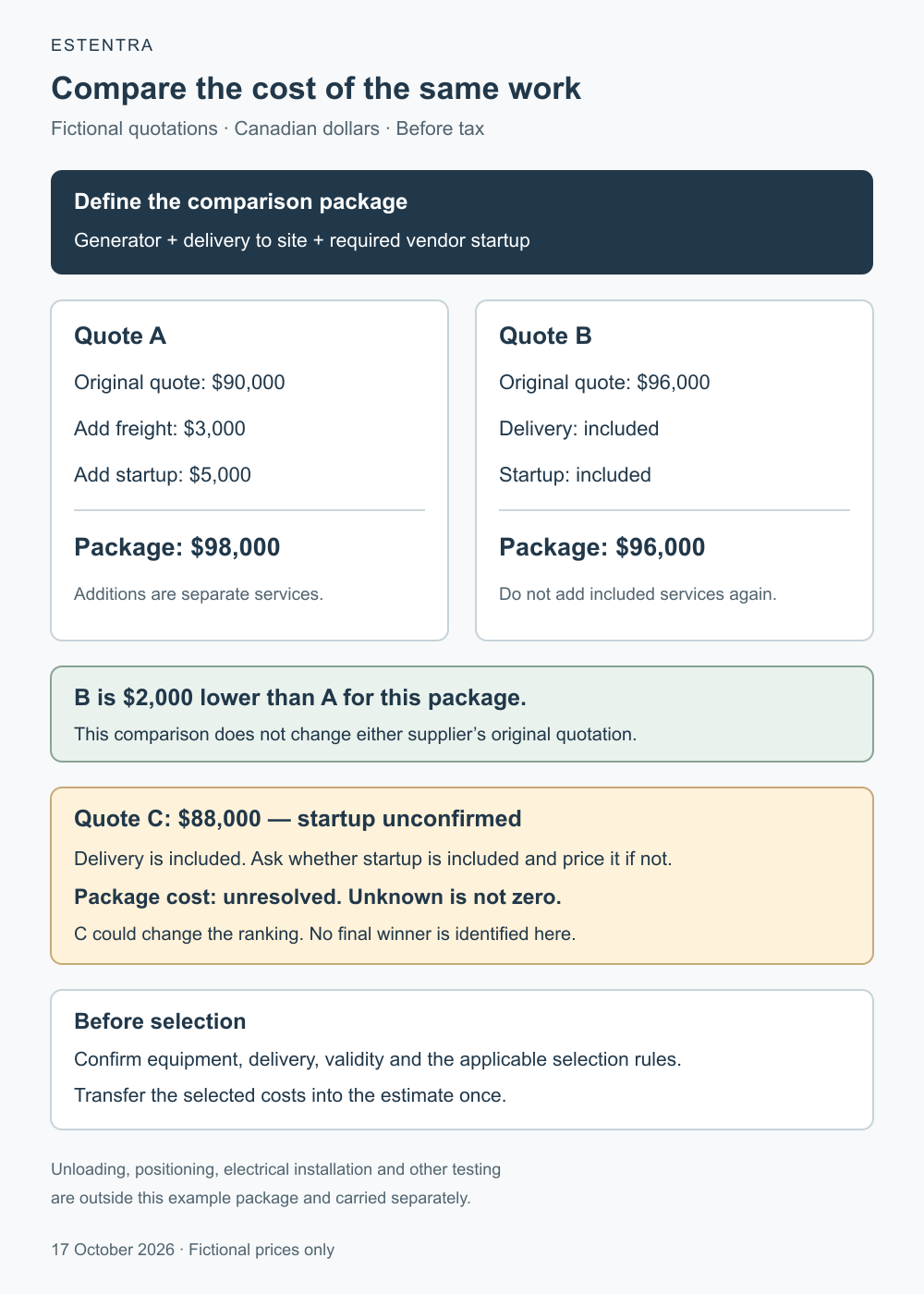
Consider three fictional quotations for the same specified generator. The comparison package covers the generator, delivery to site and the required vendor startup service. Assume the quoted equipment meets the specified technical requirements and delivery schedule.
All amounts below are in Canadian dollars, before tax. Unloading, positioning, electrical installation and other project testing are excluded from this comparison and carried separately in the fictional project estimate. These example amounts are not current market rates.
- Original quoted amount — Quote A: $90,000 — Quote B: $96,000 — Quote C: $8,000
- Delivery to site — Quote A: Excluded; separate freight quote $3,000 — Quote B: Included — Quote C: Included
- Required vendor startup — Quote A: Excluded; separate acceptable startup quote $5,000 — Quote B: Included — Quote C: Not confirmed
- Cost for the defined package — Quote A: $98,000 — Quote B: $96,000 — Quote C: Unresolved
For Quote A, the calculation is $90,000 + $3,000 + $5,000 = $98,000. The extra $8,000 would be paid for the separately arranged services; it is not a revised offer from Supplier A.
Quote B is $2,000 lower than A for this defined package. Its “included” entries mean those services are already covered by the $96,000 quotation, so they are not added again.
Quote C cannot yet be compared on the same basis because startup is unconfirmed. Ask whether the required startup service is included and obtain its cost if it is not. Do not treat $88,000 as a complete package price. The example does not establish a final winner among all three quotes.
4. Check delivery and other requirements before choosing
A lower checked cost is only one part of the decision. Confirm that the quoted equipment is acceptable, the required services are available and delivery fits the construction schedule. Check what starts the lead-time period: for example, order placement, deposit or approval of submitted product information.
Record important differences instead of hiding them in a price adjustment. If one supplier cannot meet the required delivery date, show that issue and seek a confirmed solution. Do not invent a delay cost just to make the comparison appear complete.
The Competition Bureau's guidance for public procurement authorities recommends considering relevant non-price factors, including quality, service and supplier reliability, with clear evaluation criteria. [2] For your comparison, follow the selection rules that apply to the project. This estimating check is not permission to change formal bid-evaluation rules or assume an unacceptable offer can be made acceptable by adding an internal cost.
5. Transfer the selected scope and cost into the estimate
Before relying on a quote, confirm its revision, validity, included services and unresolved conditions in writing. Keep the supplier's offer and your comparison notes together.
If Quote A were selected in the example, the estimate would need both its $90,000 equipment quotation and the $8,000 of separately arranged services. If Quote B were selected, its $96,000 already covers those services. In either case, check that delivery and startup have not also been added elsewhere.
For a subcontract quote, perform the same check against your own labour, material and equipment items. If the subcontractor includes work you have already priced, decide which cost will remain in the estimate and record why. Do not leave both costs in the total or remove a supplier charge that still has to be paid.
Where tender or bid-depository rules apply, follow their requirements for clarifications, revisions and selection. Keep unanswered questions visible until they are resolved or the authorised reviewer records how they will be handled.
Before relying on the comparison
Check that every total covers the same defined work, every addition has a source, and every “included” entry is supported by the quotation or written confirmation. Keep provisional estimates and unknown costs clearly labelled.
The comparison should explain the decision to another estimator: what each supplier offered, what extra work you allowed for, what still needs an answer and how the selected costs reached the estimate.
References
- Procurement Assistance Canada: Preparing to bid on an opportunity, “Review and understand an opportunity.” Federal procurement context.
- Competition Bureau: Unlocking competition in public procurement, section 3, “Look at more than just price.” Guidance for public procurement authorities.
References checked 17 October 2026. The comparison method and generator quotations are original educational examples. No supplier quotation or current price is represented.
General estimating workflow guidance. Project requirements and contractual documents take precedence; this is not electrical design or code-compliance advice.