Estimating workflow
Separate installed quantities from purchase quantities
Separate measured work, material allowances, pack rounding and cut lengths before pricing or ordering.
6 min read
Keep the measured work, material allowances and order quantities visible as separate steps.
The quantity you measure is not always the quantity you buy. A takeoff might show 240 m² of material required in position, while the supplier sells only whole packs. A cable takeoff might total 180 m, while the individual lengths cannot be cut from the reels you first planned to order.
Keep the original measurement and show how you turn it into a purchasing requirement. That lets another estimator check the material cost without losing the quantity of work being installed.
1. Start with the measured work
Record the item, type, size, location, drawing revision, measured quantity and unit. Keep different products separate even if they use the same unit. A spare length of one cable type cannot automatically satisfy a requirement for another.
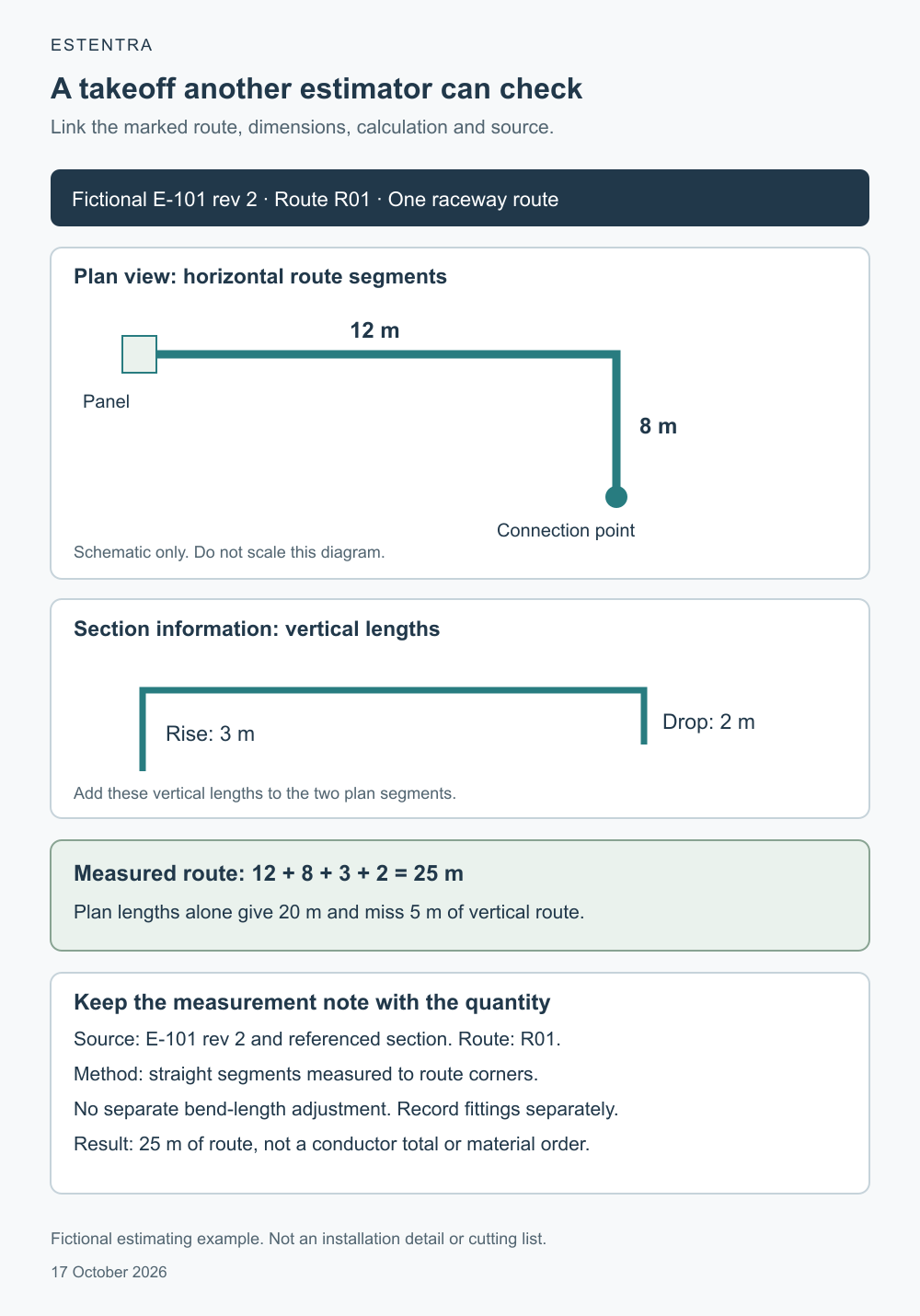
State what the measurement includes. For cable, a route measurement alone may not include the length needed inside equipment or at terminations. Identify those required lengths before preparing the order. They are lengths needed to complete the installation, not a substitute for an unexplained waste percentage.
Keep this takeoff unchanged when you add purchasing allowances. If the design changes, revise the measured work first and then recalculate the material requirement.
2. Explain each addition
List additions separately and say why they are needed. Depending on the item, they might include cutting loss, expected damage or a specified spare quantity. Record quantities or percentages and the amount to which a percentage is applied.
Use project evidence, a checked cutting plan or comparable purchasing records to justify an allowance. Do not apply one waste percentage to every material. A percentage does not show whether individual pieces will fit within a stock length.
Check what is already included in the takeoff, assembly or supplier package. If termination lengths or spare items have already been added, adding them again under a general allowance overstates the requirement.
For a simple allowance applied to the measured quantity:
Material requirement = measured quantity × (1 + allowance rate).
This formula shows the arithmetic only. It does not establish the appropriate allowance or replace checks of cuts, stock lengths and packaging.
Example: allowance and whole-pack rounding
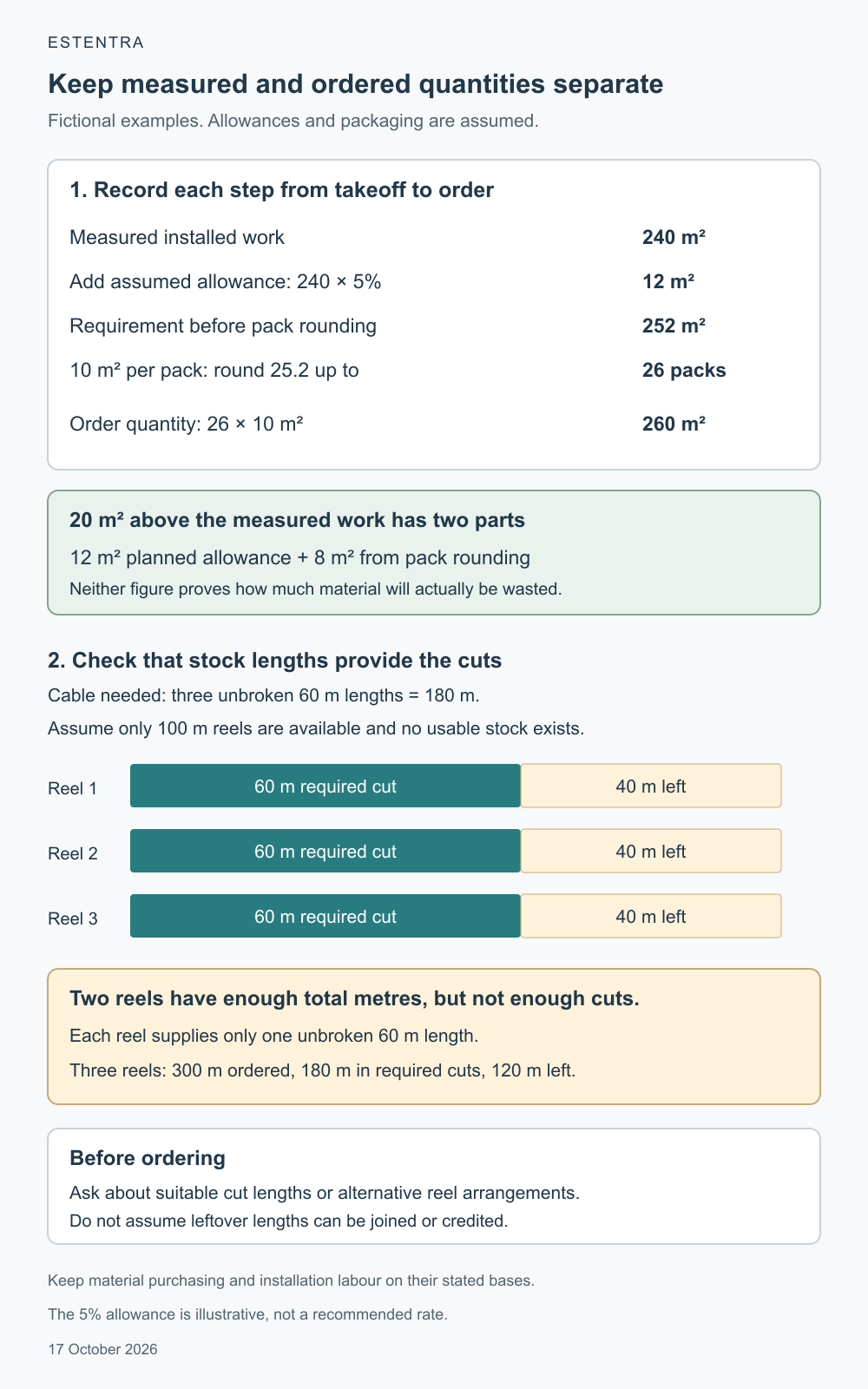
Consider a fictional sheet-material item with 240 m² required in position. For this calculation, assume a reviewed cutting layout supports a 5% material allowance, and the selected product is sold in packs containing 10 m². These are teaching assumptions, not a recommended waste rate or a real product specification.
| Step | Calculation | Result |
|---|---|---|
| Measured work | From the takeoff | 240 m² |
| Stated material allowance | 240 × 5% | 12 m² |
| Requirement before pack rounding | 240 + 12 | 252 m² |
| Whole packs needed | 252 ÷ 10 = 25.2; round up | 26 packs |
| Quantity ordered | 26 × 10 | 260 m² |
| Extra quantity from pack rounding | 260 − 252 | 8 m² |
The order is 260 m², but the measured work remains 240 m². The difference of 20 m² consists of a 12 m² planned allowance and 8 m² from rounding to whole packs.
Do not describe all 20 m² as actual waste. The allowance is a planning assumption, and the extra material may remain usable. Record what was used, damaged, returned or retained when actual purchasing information becomes available.
The example assumes the piece layout has already been checked. Dividing total area by pack coverage does not, by itself, prove that the sheets provide the required shapes and sizes.
3. Check individual cuts before ordering cable or stock lengths
Consider a second fictional requirement: three unbroken cable lengths of 60 m each. The 60 m already includes the required end lengths for this example. Assume there are no usable offcuts in stock and the supplier offers only 100 m reels for this purchase.
The required cable totals 3 × 60 = 180 m. Two 100 m reels provide 200 m in total, but they cannot provide three separate 60 m lengths. Each reel gives one 60 m length and leaves 40 m. Neither remainder is long enough for the third length.
Under those assumptions, you need three 100 m reels, providing 300 m, with 120 m left after the three cuts. That is a result of the available reel lengths and the required cuts, not a percentage-based waste allowance. Do not assume the 40 m remainders can be joined to satisfy an unbroken-length requirement.
Before accepting that order, ask whether the supplier can provide suitable cut lengths or another reel arrangement. Southwire, for example, advertises cut-to-length services through SPEED Services. [1] Confirm availability, charges, supplied lengths and delivery for the actual product and supplier; the example does not promise that this service is available for your order.
Keep a cut-by-cut record rather than relying on the aggregate length. Any alternative order still needs to provide every required unbroken length and meet the project requirements.
4. Match the purchasing unit to the price
Check whether the quotation is priced per item, pack, metre, reel or another stated quantity. Multiply by the corresponding order quantity.
In the sheet example, a price per pack is multiplied by 26 packs. A price per square metre is multiplied by 260 m², if the supplier charges for the full area ordered. Multiplying a pack price by 260 would mix packs and square metres.
Confirm minimum order quantities, pack contents, stock lengths and any cutting or delivery charges with the supplier. Check the selected product and quotation rather than assuming a packaging size from an earlier job.
5. Keep labour quantities separate
Do not automatically increase installation labour by the same percentage used for material purchasing. The sheet example still has 240 m² of measured installed work; ordering 260 m² does not establish 260 m² of installation.
Check what the labour rate covers. Cutting, handling, sorting, returning surplus and other tasks may need labour, but price them on their stated basis rather than treating every purchased unit as installed work. Avoid adding the same task when it is already included in an assembly or labour allowance.
Likewise, the cable example's unused reel lengths do not establish additional installed cable. Keep the required cuts, ordered material and labour assumptions separate.
Before pricing or issuing an order
Check that the record shows the measured work, each addition, the available pack or stock size and the final quantity to buy. For cut materials, confirm that the proposed order can provide every individual piece. Identify any suitable existing stock separately so it is not counted twice.
Keep leftover material distinct from material expected to be lost. Its possible reuse or return needs confirmation; do not assume a credit when pricing the purchase.
The order should be traceable back to the takeoff without replacing it. That makes it easier to explain the cost, review a revision and compare the original plan with what was actually purchased and installed.
Reference
- Southwire: SPEED Services, service description identifying cut-to-length options. Used only as an example of a purchasing service, not as a product recommendation or guarantee of availability.
Reference checked 17 October 2026. All quantities, packaging, reel lengths and allowances in the examples are fictional. The calculations do not select a cable, approve a joint or establish an installation method.
General estimating workflow guidance. Project requirements and contractual documents take precedence; this is not electrical design or code-compliance advice.