Tender preparation
Late Addenda: Check Supplier-Quoted Quantities Before Closing
Trace a late quantity change from the addendum and revised takeoff to the supplier quote, and keep unanswered pricing clear before closing.
6 min read

Illustrative photograph by Tima Miroshnichenko on Pexels, used under the Pexels License. Pexels-provided resized image; no other changes.
An addendum changes the drawing, we update the takeoff, and the supplier confirms receipt. Our number can still contain the old quantity and price.
The check is whether the revised requirement has reached the supplier’s quotation and our estimate. Sending the documents starts that work. It does not finish it.
This article follows one quantity change from an addendum to an outstanding supplier price. Use the actual tender instructions for questions, revisions and submission. Procurement Assistance Canada advises federal bidders to monitor amendments and follow the requirements of each solicitation. Those instructions are specific to the procurement; they are not one set of rules for every Canadian electrical tender. Preparing to bid on an opportunity.
Example notice: Project scenarios and pricing examples created for these articles are fictional and for educational use only.
Start with the document that changed
In our example, the original takeoff includes five L1 luminaires on drawing E-201, Revision 1. The lighting supplier’s quotation Q-147, Revision 0, lists five L1 luminaires and identifies that drawing revision as its pricing basis.
Addendum 03 replaces E-201 with Revision 2. The revised drawing adds two L1 luminaires, bringing the requirement to seven.
Save the addendum and replacement drawing with the tender documents. Keep the previous takeoff and quotation identifiable. Record which drawing was replaced, what changed and who is checking the effect on our number.
Read the addendum’s written instructions as well as the drawing. Check whether the luminaire schedule, accessories, controls or installation requirements also changed. A count difference alone does not describe the full pricing effect.
Recount the affected work
Recount the area affected by the revision. Check the luminaire tag against its schedule description so the seven required units and five quoted units refer to the same item.
| Check | Recorded requirement |
|---|---|
| Previous drawing | E-201, Revision 1 |
| Previous L1 takeoff | 5 each |
| Addendum | 03 |
| Replacement drawing | E-201, Revision 2 |
| Revised L1 takeoff | 7 each |
| Quantity in quotation Q-147, Revision 0 | 5 each |
| Quantity not covered by that quote line | 2 each |
The revised count is seven. The existing quote line covers five. The two-unit difference needs a pricing response.
Also check whether the supplier quotes individual luminaires, cartons or a complete package. Compare quantities on a confirmed common basis. Do not assume that an unexplained “1 lot” covers every item in the revised takeoff.
Check what the supplier actually priced
Open the quotation and its attachments. Check the document list, quotation revision, item descriptions, quantities and exclusions.
A quotation dated after the addendum may still use the earlier drawings. The date tells us when the supplier issued the offer; it does not establish which requirements were priced.
For this example, the supplier needs to confirm that its revised offer covers Addendum 03 and E-201, Revision 2, including seven L1 luminaires with the required specification and accessories.
If the quotation says “all addenda included” but still lists five L1 luminaires, leave the discrepancy open. Ask whether the line quantity is wrong, the additional units are included elsewhere, or the price still covers only five. Do not decide which explanation applies without supporting information.
Send a specific request to the affected supplier
Send the issued revision to the lighting supplier with a short explanation of the pricing action required. Identify:
- Addendum 03 and replacement drawing E-201, Revision 2.
- The L1 quantity change from five to seven each.
- The existing quotation and line that still show five.
- Any associated specification or accessory changes.
- When the revised written offer is needed for review.
Check the rest of the electrical estimate separately. The supplier may price luminaire supply while our estimate carries installation labour, supports, connections and other work. Review the affected work rather than assuming the supplier’s price adjustment completes the estimate change.
The BC Documents Committee’s BCDC 2–2024 guidance specifically discusses allowing bidders, subcontractors and suppliers time to incorporate late addenda. It is guidance for that British Columbia document set, not a promise that every late addendum extends closing. BCDC 2–2024 Guide, Guideline 1.2, clause 5 commentary.
Keep receipt separate from corrected pricing
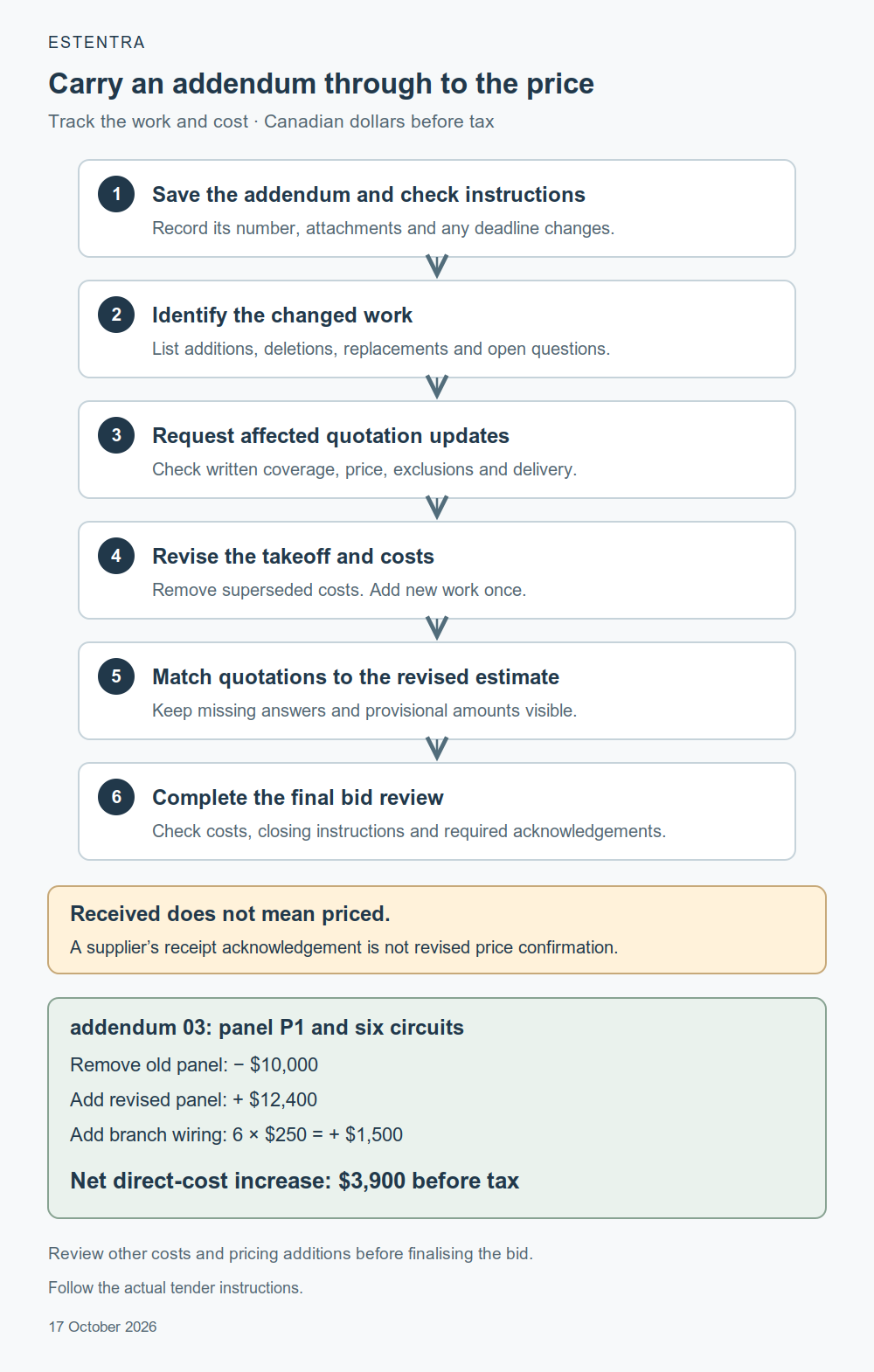
The supplier replies, “Received, reviewing.”
That confirms receipt. It does not confirm that seven luminaires have been priced.
Keep these steps separate:
| Step | What it establishes |
|---|---|
| Revision sent | We forwarded the identified documents |
| Receipt acknowledged | The supplier confirmed receipt |
| Revised offer received | We have a new offer to review |
| Revised offer checked | We checked its revision basis, quantities, scope and price |
| Estimate updated and reviewed | The checked change has reached our number |
Do not mark the supplier item complete at the second step. A revised offer still needs checking before it replaces the quotation already carried in the estimate.
Review the whole revised offer
When corrected pricing arrives, compare it with both the revised requirement and the previous offer.
Confirm the seven L1 luminaires, their identity and the applicable drawing revision. Check whether the new offer replaces the full lighting quotation or adds a separate amount. Review any changed exclusions, freight, delivery conditions or other qualifications.
Do not automatically price the two additional units using the previous unit rate. Confirm whether that rate applies to the additional quantity. A supplier may revise the package price or other terms.
Keep the supplier’s original amounts separate from any estimator adjustments. If we make an internal allowance while waiting, identify it as our allowance, with its basis and approval. It is not corrected supplier pricing.
When replacing a complete quotation, remove the superseded amount from the estimate. When carrying an additional amount, confirm that it has not already been included in the replacement total.
Leave an unanswered price open before closing
In this example, the supplier has acknowledged Addendum 03 but has not returned corrected pricing by the internal review deadline.
The closing review should therefore show:
Open — L1 supply quantity and price: Revised takeoff requires seven each under Addendum 03, drawing E-201, Revision 2. Quotation Q-147, Revision 0, lists five each against Revision 1. Two additional units are not confirmed in supplier pricing. Receipt acknowledged; revised offer outstanding. The lighting estimator owns the follow-up, and the estimating manager must decide how to proceed before our quote is released.
Record the actual response deadline and the decision taken. Resolve any unclear scope through the permitted communication route. If management approves an internal pricing allowance, keep the supplier confirmation outstanding until it is received and checked.
Internal approval does not change the tender instructions or make a qualification acceptable. Do not assume that an unanswered item can be corrected after closing.
The final record should connect the issued revision, revised takeoff, supplier response and amount carried in our number. If one of those is still missing, show it clearly before submission.
General estimating workflow guidance. Project requirements and contractual documents take precedence; this is not electrical design or code-compliance advice.